The Real Question Isn't "Is Nepal Safe for Kids" — It's "What Age Does What"
Every family enquiry that comes into Everest Luxury Holidays starts the same way. Someone asks if Nepal is safe for children. It almost always is, in the way that matters. Kathmandu's better hotels are as secure and well-run as anything in London or Dubai. Chitwan's lodges have been hosting families for decades. The real question is fit, not safety.
A two-year-old and a twelve-year-old cannot do the same trip in Nepal. Pretending otherwise is how families end up with an itinerary nobody enjoys: a toddler dragged up a mountain pass, or a curious ten-year-old parked in a spa resort with nothing to do. The families who leave Nepal talking about it years later are the ones whose itinerary was built around what their children could actually absorb and enjoy at their specific age, not around a generic "family package" that tries to work for everyone and ends up working for no one.
Under six, the country opens up differently than it does for a school-age child. Knowing which door to walk through first changes everything downstream: the trek you do or don't attempt, the hotels that make sense, whether a helicopter replaces a hike, how Chitwan gets built into the trip. We'll go through each stage, then show what a full premium itinerary looks like when it's built around the youngest traveller rather than around a standard package.
Under 6? Skip the Trek, Not the Himalaya
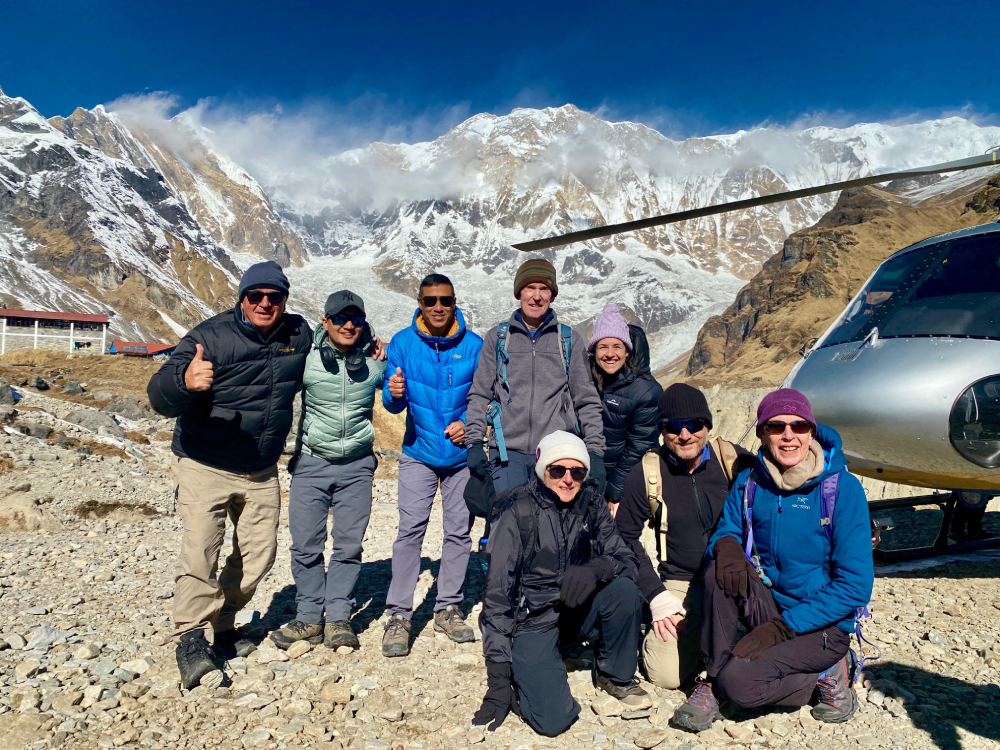
Families with very young children often assume Nepal means trekking, and that trekking means their trip is off the table until the kids are older. Neither is true. A family with a three-year-old can have a genuinely rich Himalayan experience in Nepal. It just isn't a trekking one.
Kathmandu Valley alone holds enough for a full, unhurried week. A morning at a family-run pottery workshop in Bhaktapur, where a child can sit at a wheel and get their hands covered in clay, teaches more than a viewpoint at 4,000 meters ever will. It's tactile, slow, and memorable in the way children actually remember things — rarely the postcard moment, almost always the sensory one.
A cooking session where a five-year-old rolls momos alongside a Nepali chef teaches more about the country than most itineraries manage in three days. Temple visits work the same way when they're done at a child's pace rather than a checklist pace. Swayambhunath's monkeys alone can hold a young child's attention for an hour.
These aren't consolation activities for families who can't trek yet. They match how a four- or five-year-old actually experiences a new place: through hands, food, and animals, not through altitude gain. Save the passes for later. Give this age group the valley, done properly and unhurried, and they'll leave with something real.
School-Age Kids and the Case for Poon Hill Over Everest
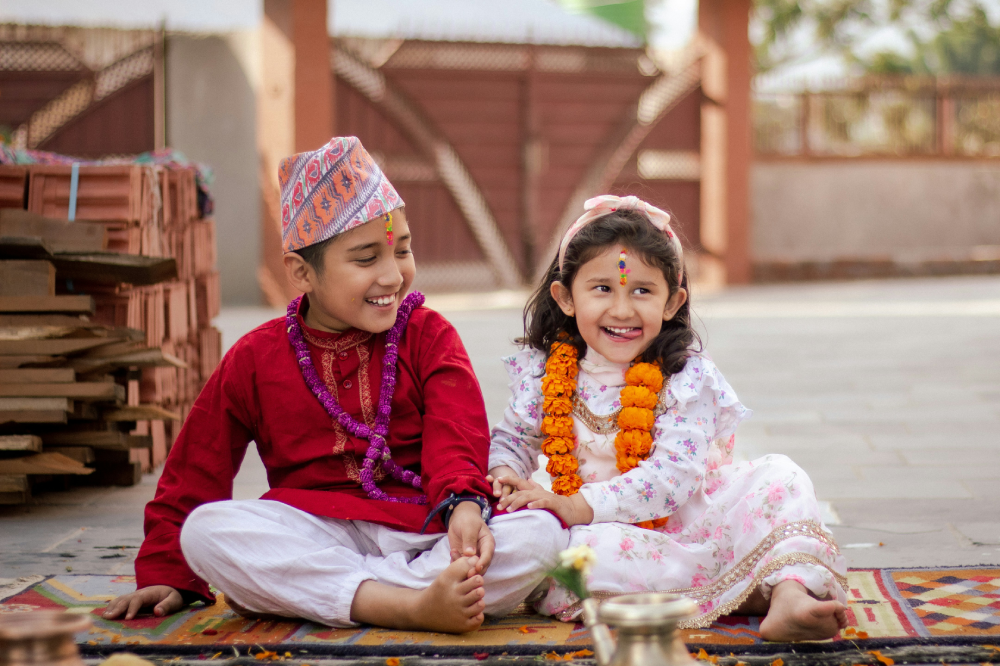
Once children are six or seven and reasonably fit walkers, trekking becomes genuinely possible. This is where most agencies make the same mistake: they steer every family toward Everest Base Camp because it's the name people know. For a family with an eight- or ten-year-old, that's usually the wrong call.
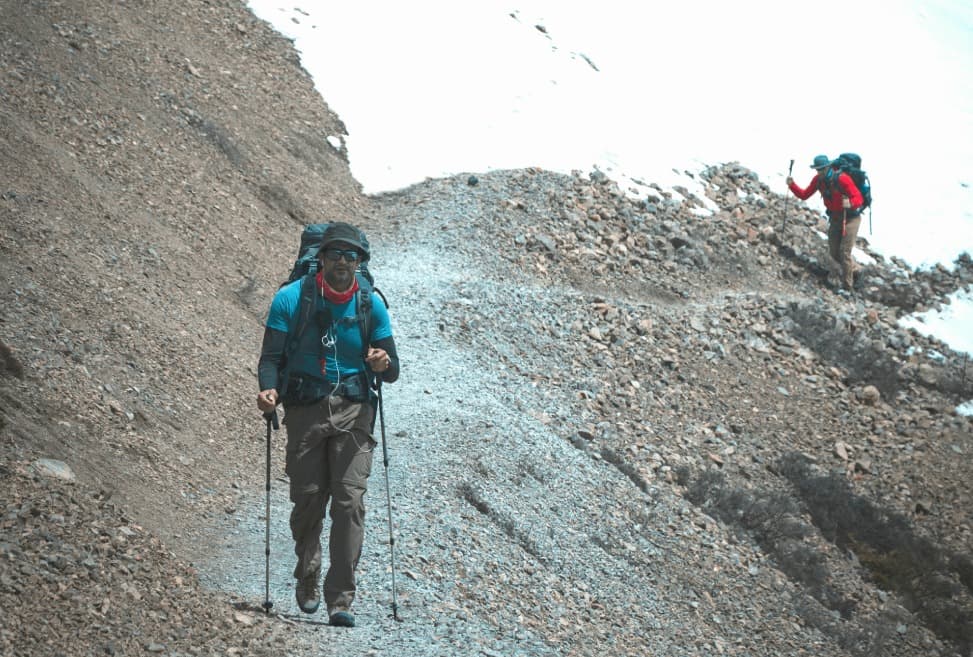
EBC is long, climbs to altitudes that affect children unpredictably, and demands daily walking hours built for adult stamina. Poon Hill, in the Annapurna region, solves almost every problem EBC creates for a young family. It's four to five days rather than twelve, the elevation gain is gradual and rarely triggers altitude symptoms in children, and the walking days are short enough that an eight-year-old finishes energised rather than depleted. The sunrise view from Poon Hill, a full amphitheatre of Annapurna and Dhaulagiri turning gold, gives a child something Everest's base camp often doesn't: they experience the moment instead of counting down the final uphill hour.
The trail itself does the rest of the work. Families walk through Gurung and Magar villages, past terraced fields still being worked, alongside mule trains carrying supplies the way they have for generations. None of it is staged for visitors. It's simply what the trail passes through, and for a child seeing rural life up close for the first time, that ordinariness is the experience.
Lodges along this route have improved considerably. For families wanting the trek without giving up comfort entirely, we build in nights at the better teahouses along the way, with a private guide who paces each day to the youngest walker rather than the itinerary.
Not every trek fits every family. See our Annapurna Heritage Trail, the route we adapt most often for families choosing Poon Hill over Everest.
Where Families Actually Stay — Kid-Friendly Luxury in Kathmandu
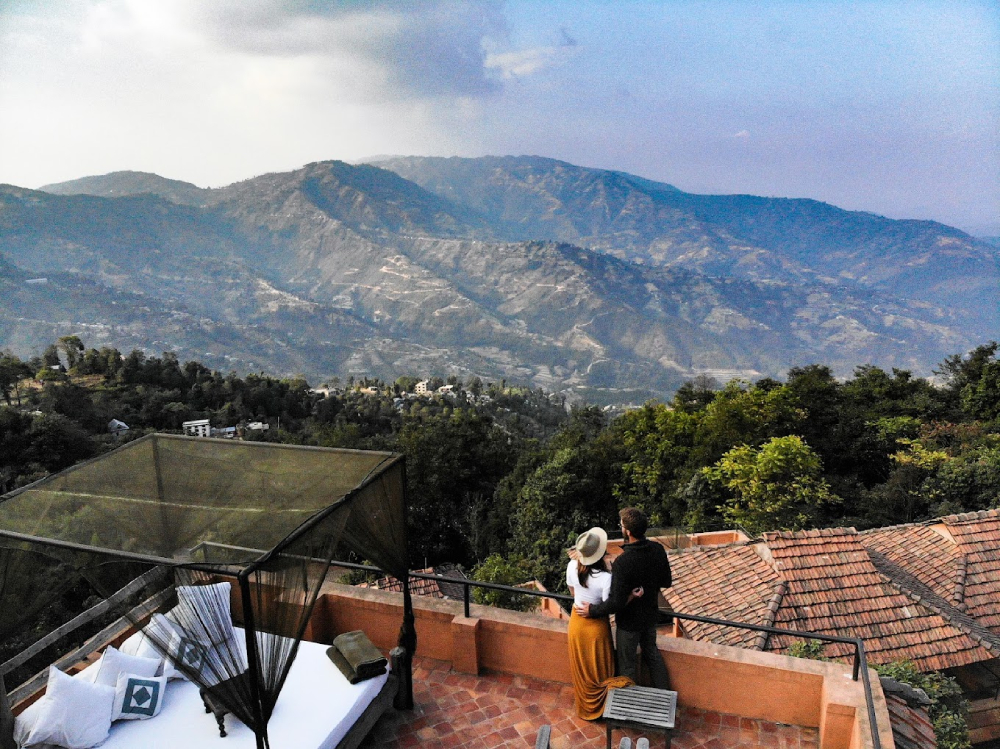
Kathmandu is usually the first and last stop on a family itinerary, and where you stay shapes the whole trip's opening and closing mood. Three properties come up most often for ELH families, each suited to a different kind of family.
Dwarika's Hotel is the choice for families who want Kathmandu's history folded into the stay itself. The property is a working museum of restored Newari architecture, with wood carvings salvaged from demolished buildings across the valley. It offers supervised childcare and babysitting on request, a playground, and a garden that gives young children room to move without leaving the grounds. It suits families with a strong interest in craft and heritage, where the parents want a slower, more contemplative base.
Hyatt Regency Kathmandu is built for families who want more structured activity. It has a dedicated children's pool, a playground, supervised kids' activities available on request, and connecting rooms, genuinely useful for two-child families who want separation without distance. The grounds are large enough that children can be occupied for an afternoon without ever leaving the property, which matters on arrival day when everyone is jet-lagged.
Aloft Kathmandu Thamel sits in the middle of Thamel itself, connected directly to a shopping complex with restaurants and a cinema. It's less a resort than a smart, modern base for families who want to walk straight out into the city: Thamel's shops, the Garden of Dreams two minutes away, Durbar Square a short walk further. Rooms are configured with connecting options, and the on-site restaurant serves a proper kids' menu. It works best for families with older children who want a city-centre base rather than a resort retreat.
None of these is marketed to us as having a formal "kids' club" in the resort sense, and we won't tell a family they do. What they offer instead is real: supervised childcare on request, family-configured rooms, and grounds or locations suited to different ages. We match the property to the family, not the family to whichever hotel has the best photos.
Private Transport and Private Helicopter Options for Families
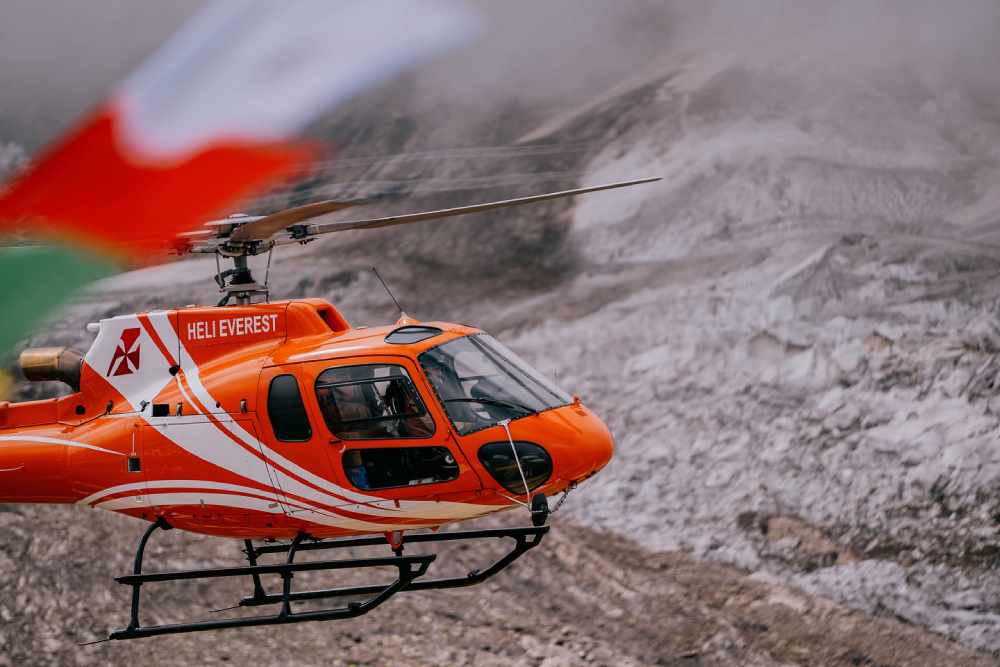
Not every family wants, or should attempt, a multi-day trek. This is where a private helicopter changes what's possible for families with very young children or limited time.
A helicopter trip to Hotel Everest View, perched above Namche Bazaar at close to 3,900 meters, puts a family face to face with Everest, Lhotse, and Ama Dablam without a single day of walking. The flight itself is part of the experience: children pressed against the window as the terraced valleys give way to glaciers is often the single most talked-about hour of the entire trip. A stay at the hotel's terrace, with the world's highest peaks framing the view, gives the whole family a genuine Everest-region experience without the altitude risk of a multi-day trek on very young legs.
For families who want more than a single flight, we build in private ground transport throughout the Kathmandu and Pokhara legs. A dedicated vehicle and driver, rather than shared transfers, matters enormously with young children on Nepal's mountain roads. It removes the unpredictability of shared shuttles and lets the day bend around a nap schedule or a child who needs an unplanned stop.
A single trip, done right, can deliver the whole Everest region to your family. See our Everest Helicopter Tour with an overnight at Hotel Everest View.
Where Chitwan Fits — And Why the Elephant Question Matters Here Too

Chitwan is where most family itineraries land in their second half, and it deserves the same honesty we bring everywhere else: we do not offer elephant-back safaris, anywhere, for any family. The welfare concerns around Nepal's captive elephant camps are real, and no luxury positioning changes what the animal experiences to get a tourist on its back. This applies as much to a family trip with children as to any other booking, arguably more, since it's a poor thing to teach a child that an animal's discomfort is an acceptable price for a photo. We've written on this at length in our full Chitwan comparison of Tiger Tops, Barahi, and Meghauli Serai, and the position doesn't change for families.
What we build instead is a premium Chitwan stay around Barahi Jungle Lodge, set on the Rapti River at the edge of the national park. The lodge holds one dedicated family suite, with two bedrooms, its own dining room and terrace, and private pool access, giving a family real separation from a standard double room without splitting the group across the property.
Days are built around a private naturalist guide who adjusts the pace to the children: jeep safaris deeper into the park for rhino and, with luck, tiger sightings; guided walking safaris along the forest edge that let kids spot birds and tracks at ground level; boat trips along the Rapti for crocodile and birdlife that ask nothing physically of a young child beyond sitting still and watching. Evening Tharu cultural performances and a village visit round out the stay without ever putting a child on an elephant's back.
This is Chitwan done as it should be for a family: wildlife access built on jeep, foot, and river, with a guide dedicated to that one family rather than a shared group timetable.
See how we build a family safari without compromising on our animal welfare standards, or book the 3-day Luxury Chitwan National Park safari and ask us to build it around Barahi's family suite.
What a Premium Family Itinerary Actually Includes
Put together, a typical ELH family itinerary runs Kathmandu, an easy trek or a Hotel Everest View helicopter trip, Chitwan, and Pokhara: roughly ten to twelve days depending on the children's ages and stamina.
What makes this different from a standard package isn't a claim we make. It shows up in the specifics. The same private guide who meets the family at Kathmandu airport is often the one who walks with them in Chitwan and sees them off in Pokhara, a single point of continuity across the whole trip, so a child isn't handed between strangers every second day, and so small preferences (a fussy eater, a napper, a kid who needs to stop and look at every dog) get carried forward rather than re-explained at each stage. Pacing is built around the youngest child in the group from the first planning call, not adjusted after the fact when a parent flags that day three was too much. Private transport runs the length of the trip rather than switching to shared transfers to save cost, which on Nepal's roads is the difference between a calm afternoon and an exhausting one.
Planning a Private Family Trip to Nepal
For families around the world, the practical planning window matters more than people expect. Nepal's clearest weather for both trekking and mountain flights falls in October–November and March–April, and these windows book out early for family-suitable lodges with limited family suites. Barahi's single family suite in Chitwan, for instance, needs to be secured months ahead for peak season. We generally recommend families begin planning six to nine months out for an October or spring trip, both to lock the right rooms and to build the itinerary around school holiday dates without compromise.
What Changes When You Build Around Your Kids
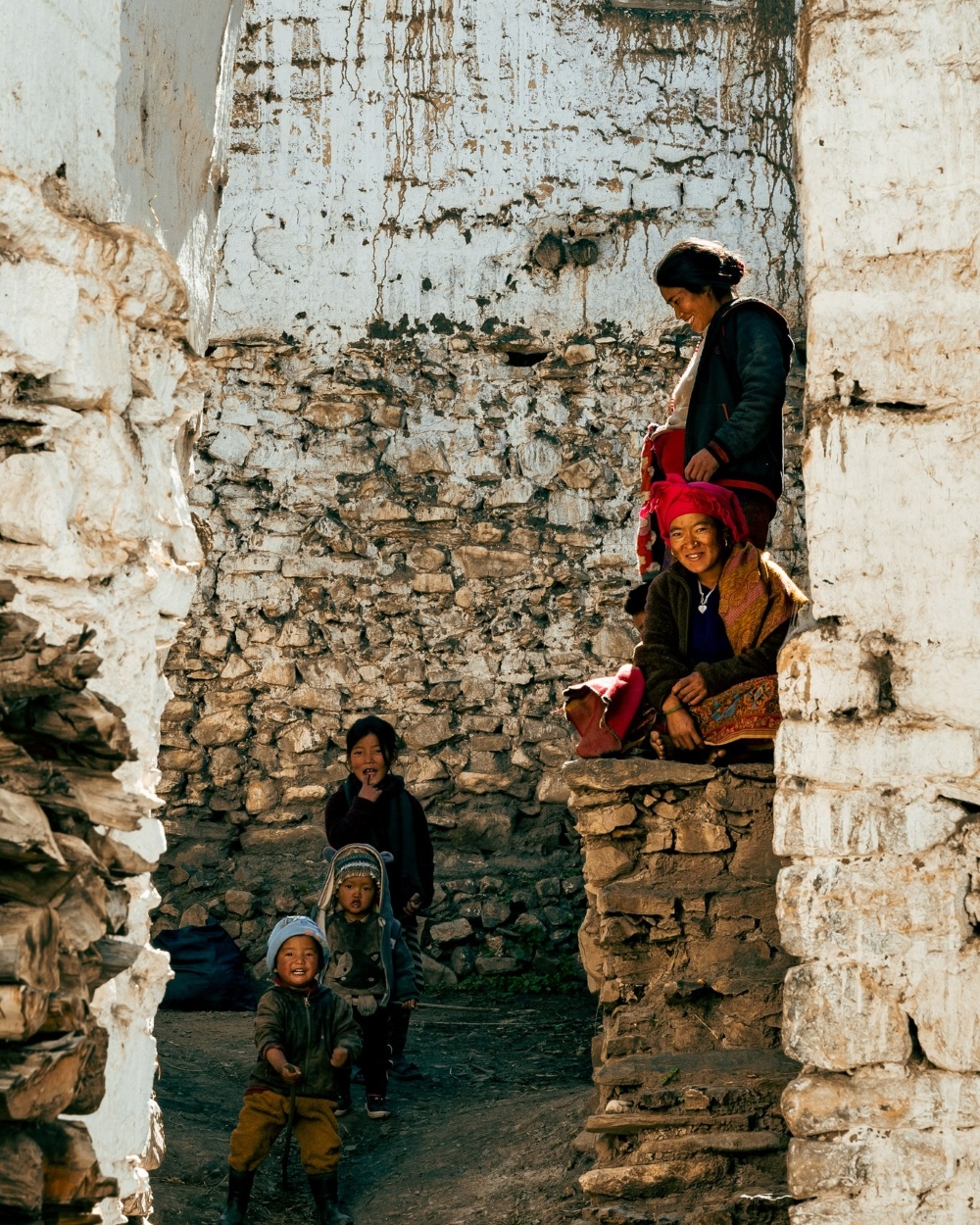
The families who come back from Nepal saying it was one of the best trips they've taken with their children never got there through a generic package. They got there because every piece- the hotel, the trek or the helicopter, the Chitwan lodge, the guide- was chosen against their children's actual ages rather than against a brochure's idea of what "family-friendly" means. A three-year-old and a nine-year-old need almost nothing in common from a Nepal itinerary, and the moment an operator stops trying to force one shape onto both is the moment the trip actually starts working.
Skip the trek for the very young without skipping the Himalaya. Choose Poon Hill over Everest when a school-age child's legs and lungs call for it. Put the family in the Kathmandu property that actually matches how they travel. Use a helicopter when it does more for the family than a week of walking would. Build Chitwan around a guide and a family suite rather than an elephant ride. None of it is complicated. It just has to be built around your children, specifically, from the first conversation.
Tell us your children's ages and travel dates, and we'll build the Nepal itinerary around them.
FAQs
What are the best luxury family resorts in Nepal?
In Kathmandu, Dwarika's Hotel, Hyatt Regency Kathmandu, and Aloft Kathmandu Thamel each suit different family styles. In Chitwan, Barahi Jungle Lodge's dedicated family suite makes it the standout choice for families wanting wildlife access without sacrificing space or comfort.
Are Kathmandu hotels kid-friendly with kids' clubs?
Kathmandu's luxury hotels don't run formal kids' clubs in the resort sense, but Hyatt Regency Kathmandu offers supervised childcare and kids' activities on request, alongside a children's pool and playground, and Dwarika's offers supervised childcare and babysitting. We match the property's actual offering to your children's ages rather than overstating what's on-site.
Is a private helicopter tour a good option for families with young kids?
Yes, particularly for families with children too young for multi-day trekking. A trip to Hotel Everest View delivers close-up Everest region views and a mountain-top stay without the altitude exposure or walking demand of a trek.
What's included in a premium family safari in Chitwan?
At Barahi Jungle Lodge, a premium family safari includes the property's dedicated family suite, a private naturalist guide for the stay, jeep and walking safaris, a river boat trip, and a Tharu village visit, with no elephant riding included or offered.
What are the safest luxury travel options for families in Nepal?
Nepal's better hotels and lodges maintain high safety standards throughout. The greater factor in a smooth family trip is matching activities to each child's age, which is why we build itineraries around age-appropriate pacing rather than a fixed package.
How do I book a private family trip to Nepal?
We recommend starting six to nine months ahead of an October or spring trip to secure family suites and school-holiday-friendly dates. Contact ELH to begin planning, and we'll handle the itinerary, guide arrangements, and visa guidance from there.