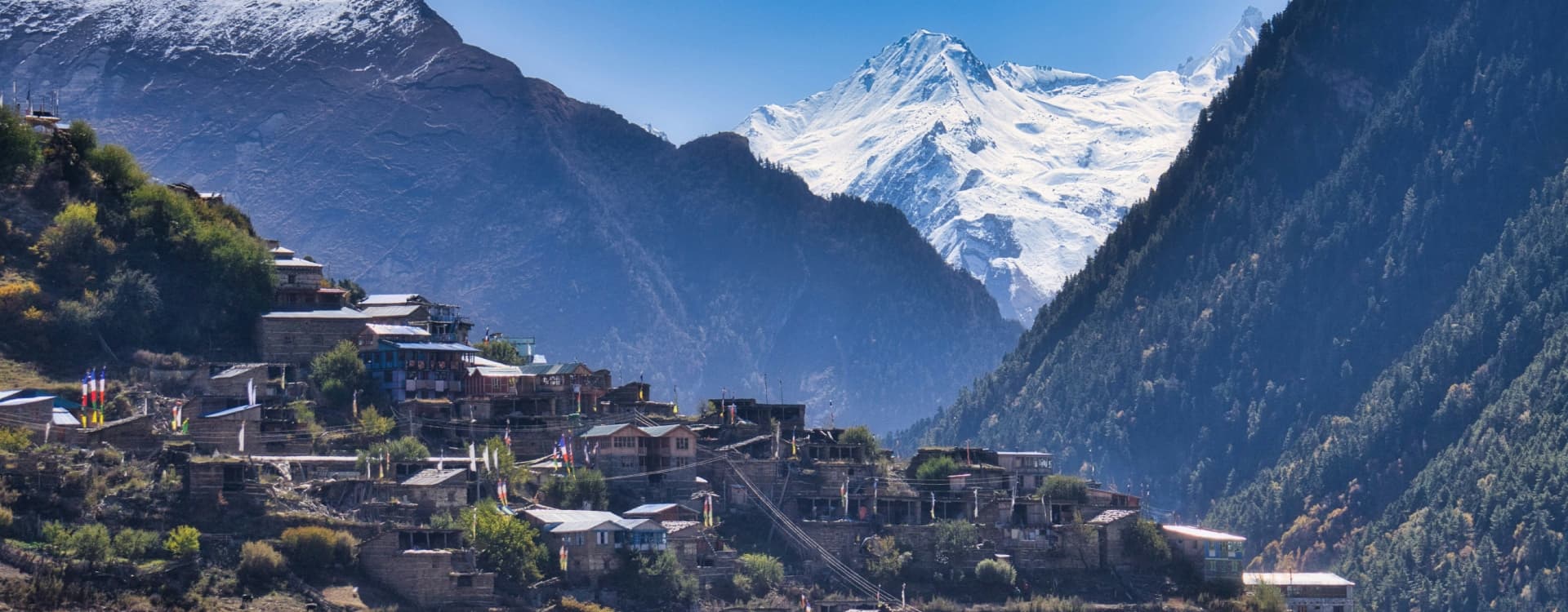
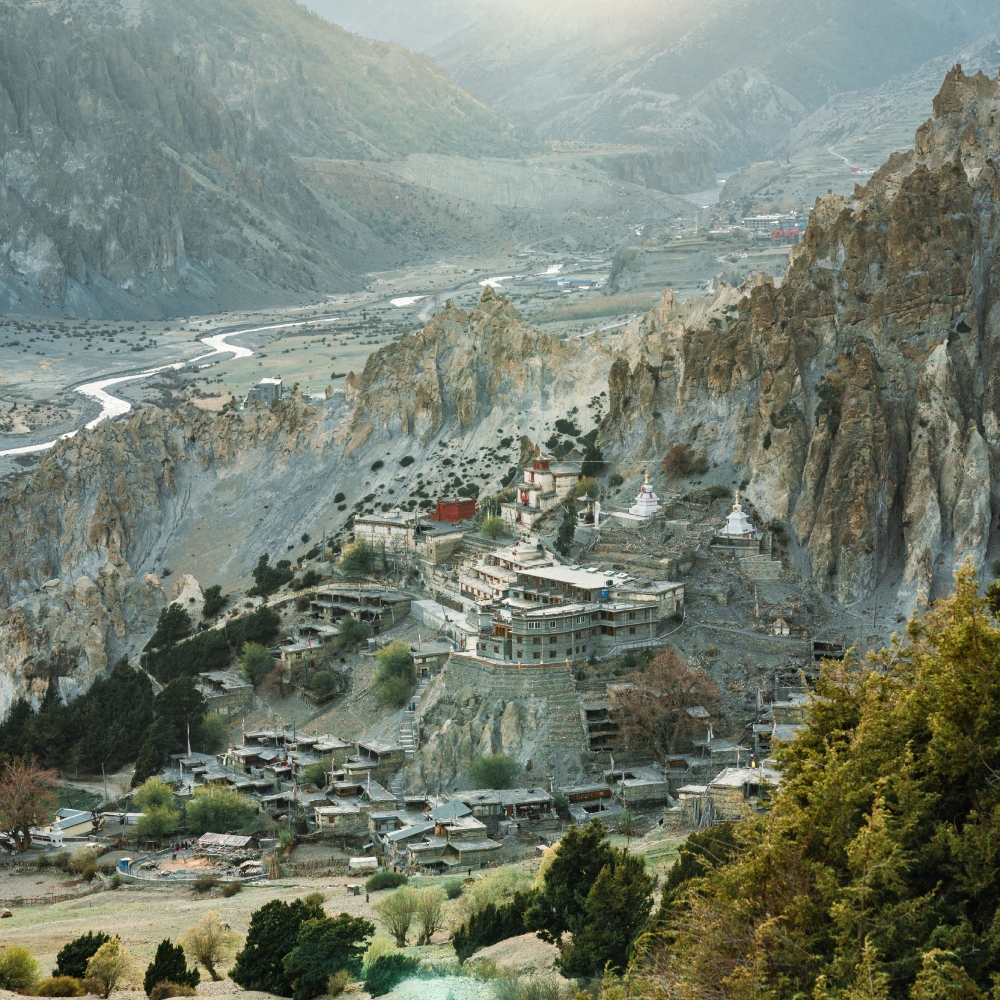
Manang sits at 3,519m in the rain shadow of the Annapurna range — high enough for real altitude, dry enough for genuine Tibetan Buddhist culture to have taken root undisturbed, close enough to reach in an afternoon if the route is right. Most travellers know it only as a stop on the Annapurna Circuit. We treat it as a destination in its own right, and design the journey there accordingly.
There are two ways in: overland by private 4WD, or by helicopter. Neither is simply faster or slower than the other — each gives you a different relationship to the place before you've even arrived. That choice, more than most people realise, sets the tone for everything that follows.
Enquire about a private Manang journey →
Getting There: Two Routes, Two Different Arrivals
Manang has no commercial airport and no scheduled road service. Every journey is private — a chartered 4WD or a chartered helicopter — and most of our itineraries break the trip in Chame or Bhraka regardless of mode, not only for altitude but because both villages reward the stop on their own terms.
Overland: Kathmandu to Chame to Bhraka
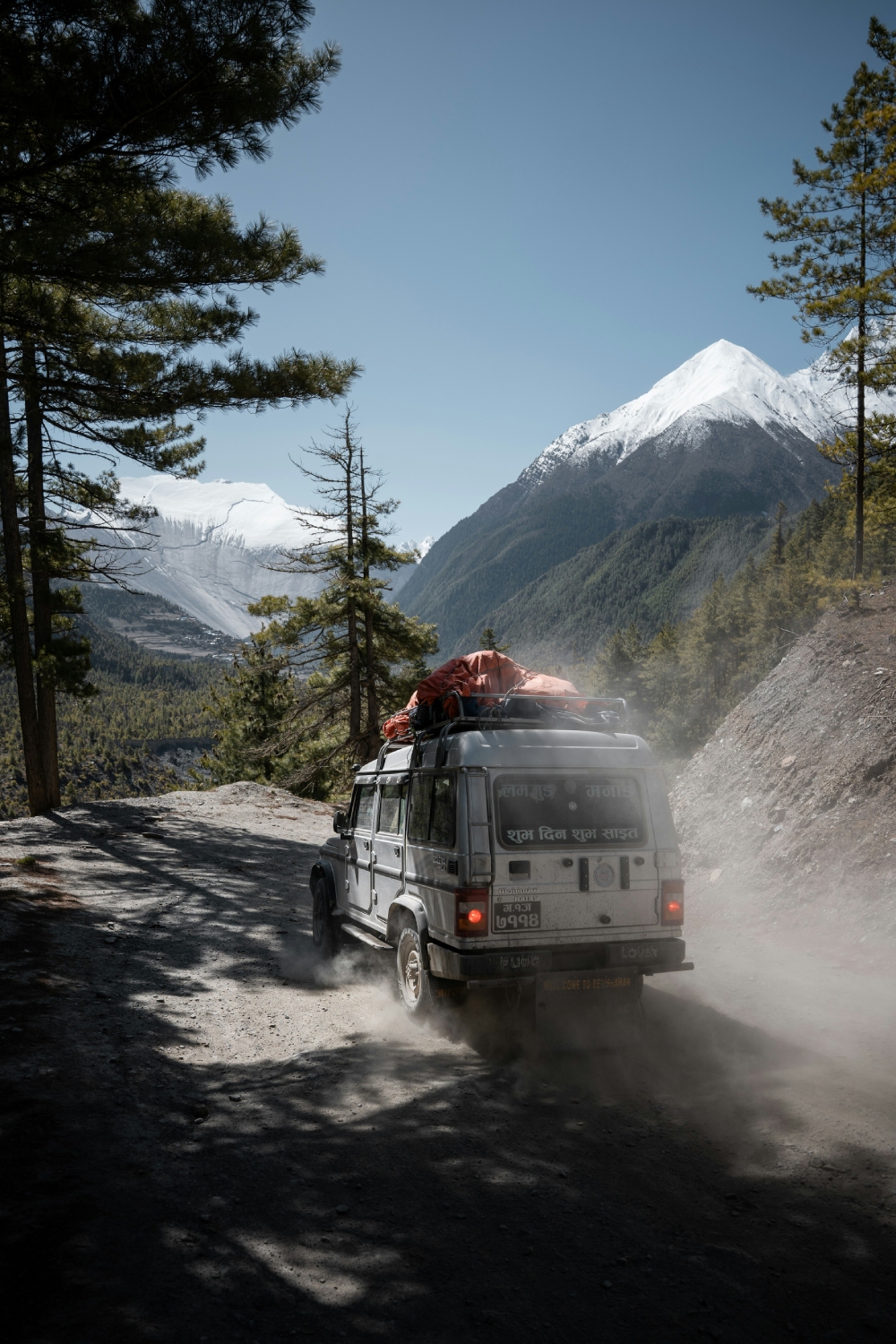
The overland route runs about six hours on paved highway from Kathmandu to Besisahar, then a further seven to eight hours on to Chame. That second stretch is a genuine mix — long plastered sections alternating with unsurfaced switchbacks — and in a private 4WD with an experienced driver, it reads as part of the journey rather than an obstacle to it.
Chame sits at 2,670m and works as a natural first night. From there, the road to Bhraka at 3,450m follows part of the Annapurna Circuit trail itself — walkable through forest and stone-stepped paths for clients who want it, or covered by private 4WD or on horseback for a quieter pace. That leg takes four to six hours and is, for our team, one of the finest parts of the entire route: gradual elevation gain paired with real contact with the valley as it actually lives.
Explore private Annapurna journeys →
By Helicopter
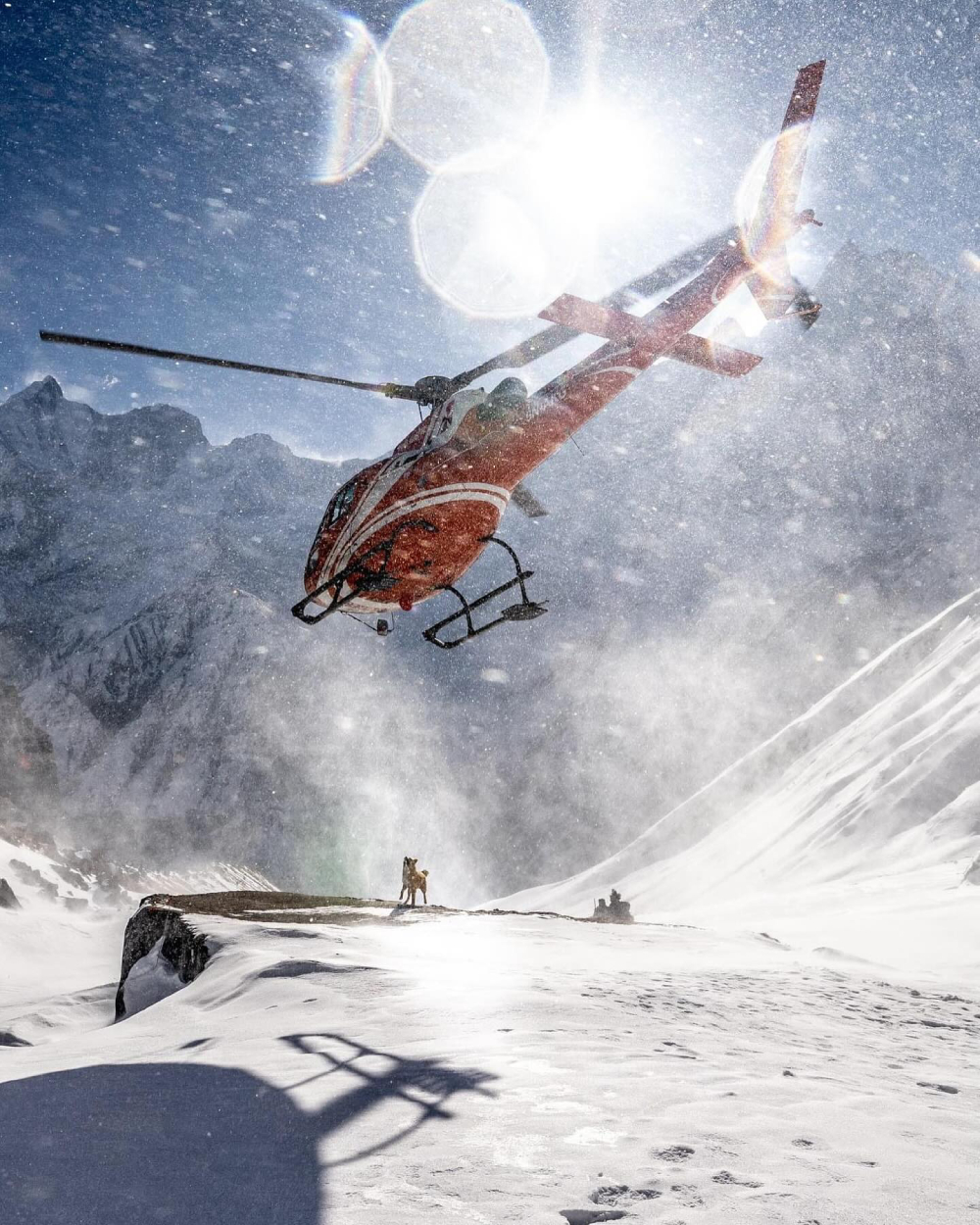
For clients working within a tighter timeframe, a private helicopter reaches Manang from Kathmandu in around an hour, or from Pokhara in about thirty-five minutes. Landing directly in Manang is possible, though we route most first-time clients through a stop in Chame — flying straight to 3,519m without any gradual elevation gain carries a real altitude risk, and we build our itineraries around avoiding it, not around the fastest possible transfer.
The flight itself follows the Marshyangdi Valley, past Lamjung Himal and Annapurna II, over terraced hillsides that shift character with every few hundred meters of elevation. Flights depend on clear weather, so we always build a buffer day into the itinerary rather than schedule a same-day return.
Explore Annapurna helicopter journeys →
Overland vs. Helicopter
| Route | Travel Time | Best Suited To | Consideration |
|---|---|---|---|
| Private 4WD | 14–16 hours, over two days | Gradual acclimatisation, village contact along the way | Mixed road surface; slower pace by design |
| Private Helicopter | 35 minutes – 1 hour | Limited time, aerial perspective on the valley | Weather-dependent; requires deliberate acclimatization planning |
Permits and Formalities
Two permits apply to travel in the Annapurna Conservation Area, and requirements here have shifted more in the past few years than in the two decades before — a licensed guide has been mandatory since 2023, and the role of the TIMS card alongside the ACAP conservation permit has changed as well. Rather than publish a figure that may be out of date by the time you read this, we confirm exact current requirements and fees directly with the Nepal Tourism Board before every journey, and arrange everything from Kathmandu. It's one detail our clients never need to manage themselves.
Where to Stay: Lodges That Belong to the Landscape
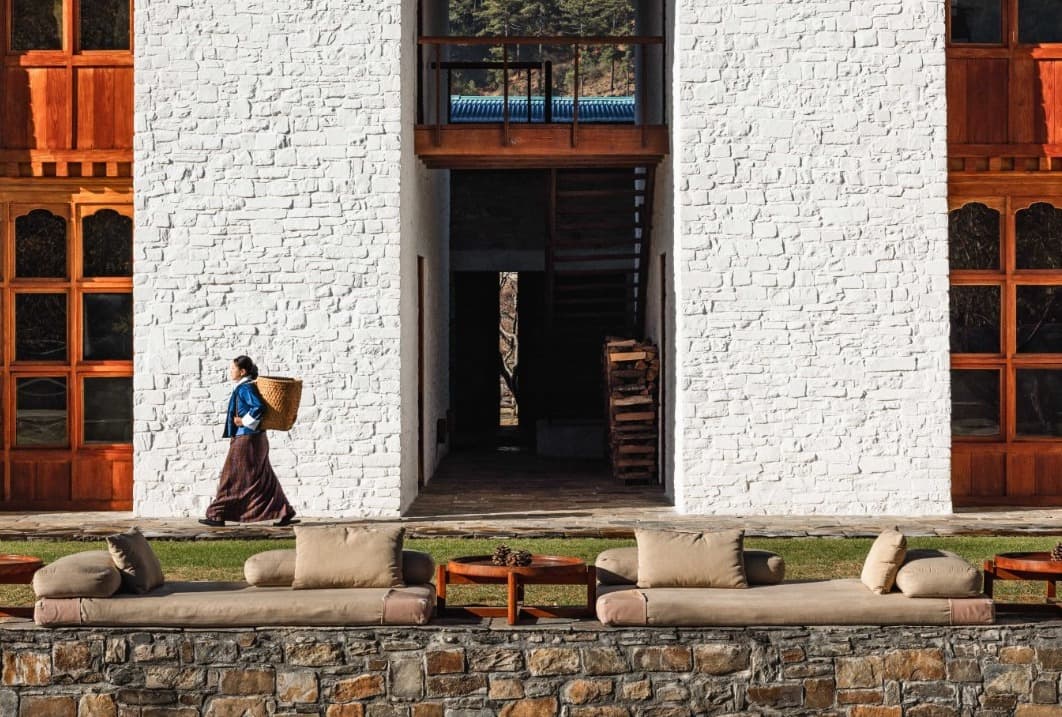
Comfortable stays this deep in the Annapurna range are a relatively recent possibility — a decade ago, they didn't exist at all. We work with two Mountain Lodges of Nepal properties in Chame and Bhraka, chosen not for brand recognition but because each sits inside the place it's meant to represent rather than apart from it.
Mountain Lodges of Nepal – Chame
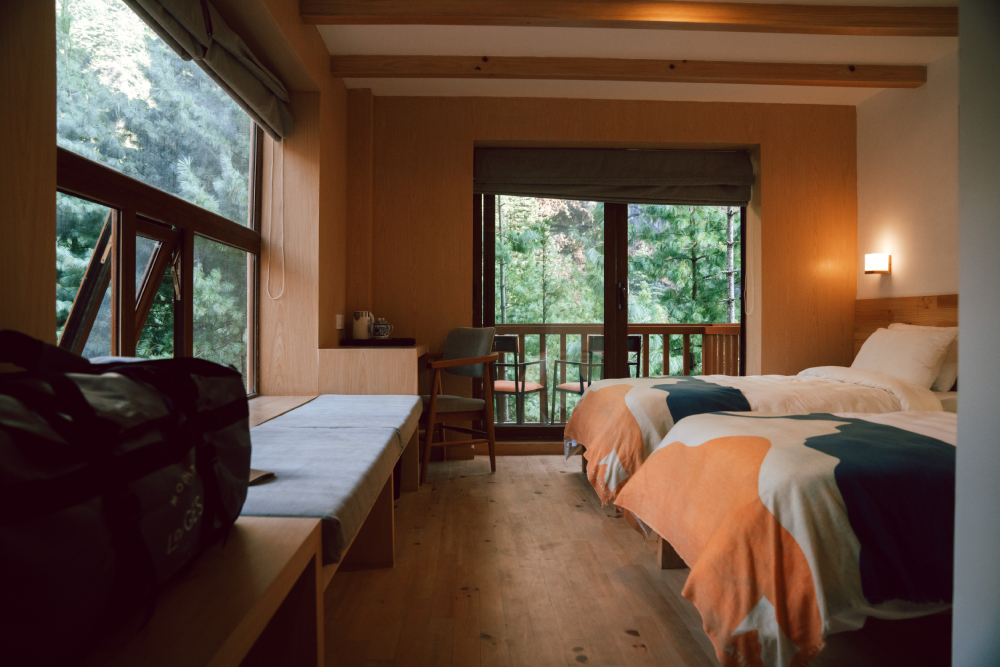
This lodge is located in Chame at an altitude of 2,670 meters. It sits on a quiet corner of the village, away from the main road. You can see Lamjung Himal from the lodge’s edge. Mornings begin slowly here, often with a cup of hot apple tea by the window. The rooms have ensuite bathrooms, heated beds, and wooden interiors. A fireplace in the dining room makes cold evenings warmer. This lodge is part of the journey, close to the trail but silent enough for rest.
Mountain Lodges of Nepal – Bhraka
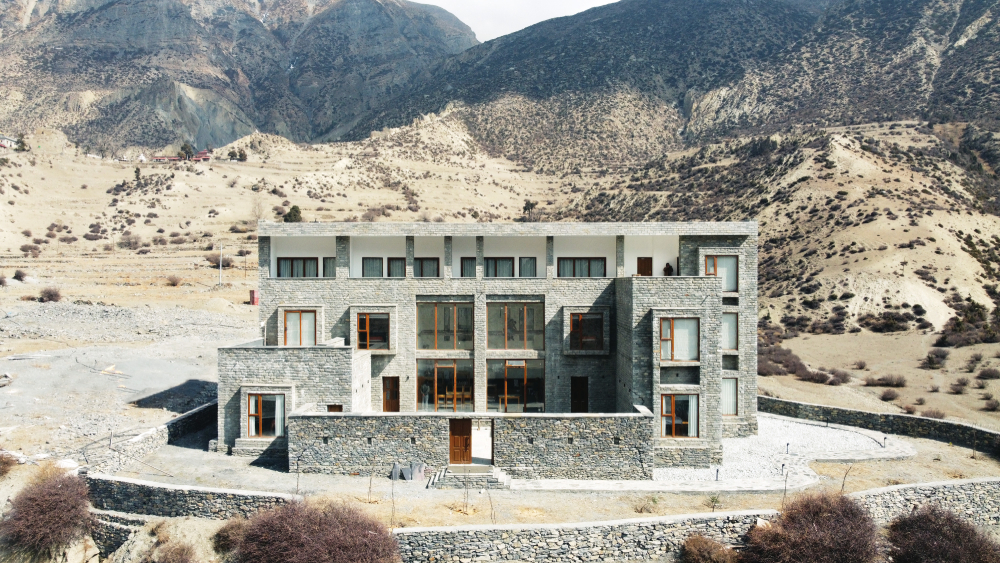
This lodge lies in Bhraka, a small village near Manang, at an altitude of 3,450 meters. The location is above the old village houses, with wide views of Annapurna II and Tilicho Peak. It feels far from everything, yet it is just minutes from the main trail. The rooms are fitted with private bathrooms and heated blankets. A wood stove keeps the common space warm at night. Guests often relax here after day hikes to lakes and valleys nearby. It offers a calm base before continuing toward Manang or higher.
Enquire about staying in Manang →
Moving Through Manang
Once you're in the valley, movement stops being about transport and becomes about pace. Most paths are wide and easy underfoot — farmland, riverbanks, old stone settlements — and we deliberately leave space in every itinerary rather than plan every hour. Staying in one place for a few days, watching the light change across the mountains, sitting with a local family over tea, tends to give clients more than another day of moving between viewpoints ever could.
What Most Travellers Never See in Manang
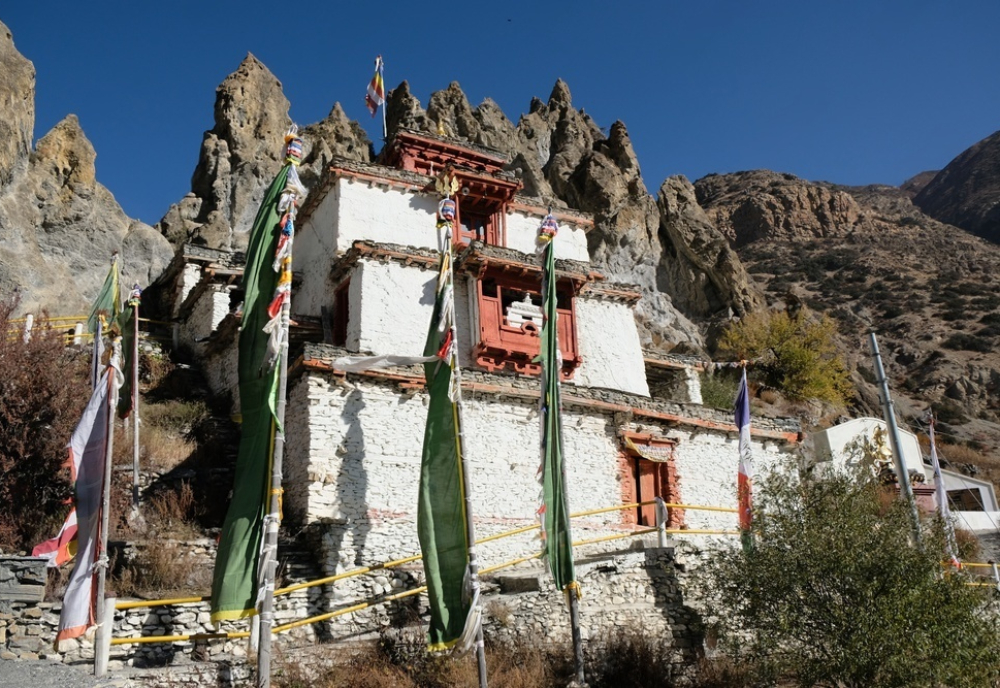
Bhraka Monastery at dawn.
It was built into the Kagyu Buddhist tradition and believed to date to the fifteenth century, Bhraka Monastery is one of the oldest working gompas in the Manang valley — older than any building in Kathmandu most travellers will see. Its ties run further back still: the site sits near a cave, some 13,450 feet up the valley wall, where the eleventh-century yogi Milarepa is said to have meditated for six years before composing the songs that Buddhist communities here still teach today. Inside, the monastery holds clay statues, carved woodwork, and manuscripts that have stayed in continuous use rather than becoming museum pieces — because the monks who live here still are the same lineage that has kept the practice unbroken for centuries. We time visits for the early morning chants whenever possible; sitting quietly through them says more about the valley's rhythm than any guide's narration could.
The other side of Chame.
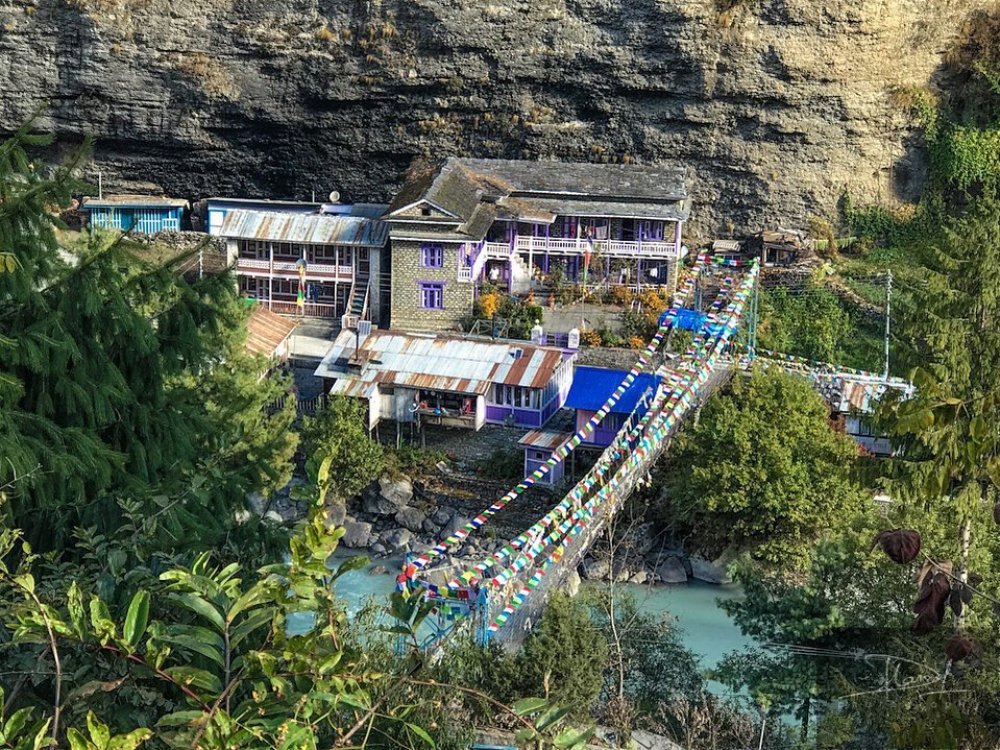
Most travellers pass through Chame only as a waypoint — a lodge for the night, a viewpoint of Lamjung Himal at dawn, then onward. Cross to the lower village, and the story changes. A handful of families still run copper stills over wood fires each autumn, turning their own apples into a clear local raksi, the same recipe passed down without much alteration for generations.
Between September and November, the orchards are still full — small, hard-fleshed apples grown at altitude, tart in a way lowland fruit never is, picked straight from branches leaning over stone-walled paths. Stop long enough, and you're likely to be handed one, or a taste of raksi still warm from the still, offered without any expectation beyond conversation. Many of these families have never lived anywhere else. That continuity — not preservation for its own sake, but simply never having left — is what's kept the orchards, the stills, and the recipes intact.
Manang town's trading history.
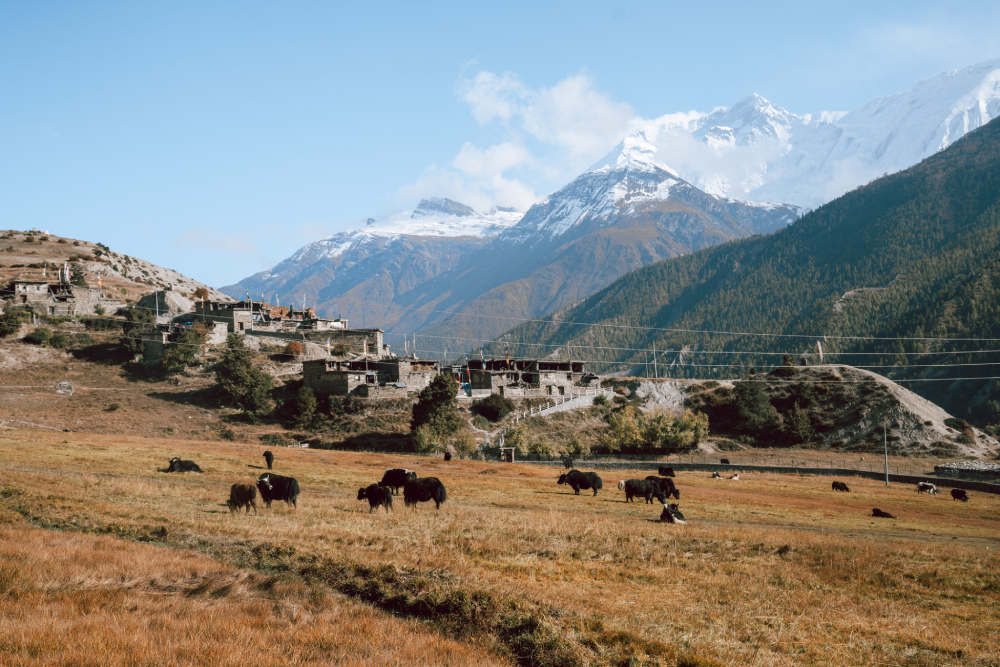
In 1784, under King Rana Bahadur Shah, Manang's traders were granted formal trading privileges that freed them from the restrictions placed on most Nepali merchants — a status that let local families trade as far as Southeast Asia in gems, wool, and medicinal herbs. It's part of why the town feels different from other mountain settlements: it was never purely a subsistence economy. That history is still visible today, in houses built a size larger than the altitude would suggest, and in a village square where goods still occasionally arrive by pack animal.
The lakes and passes beyond.
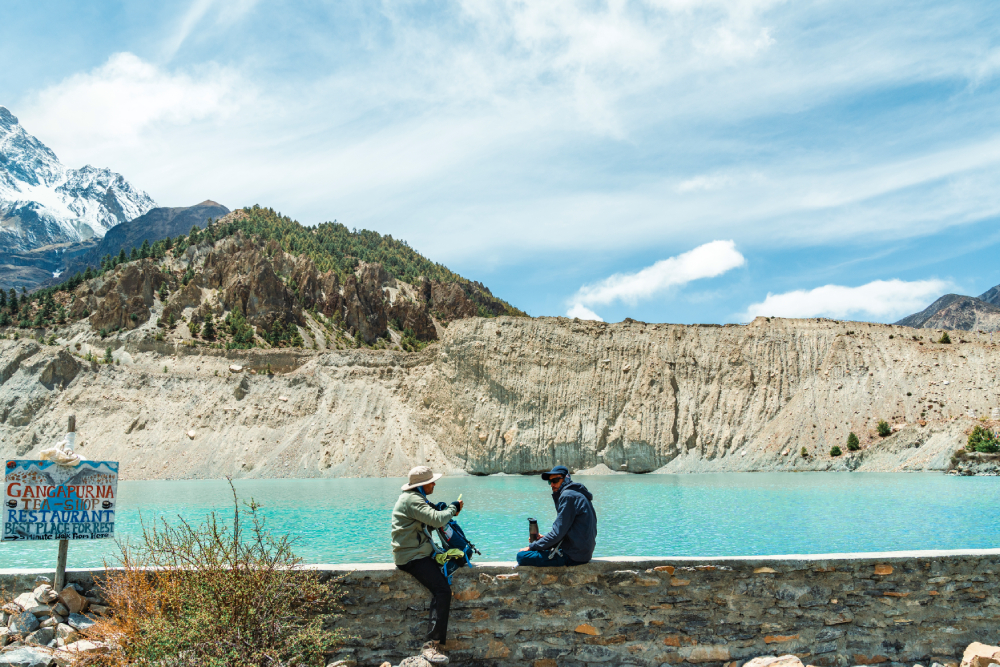
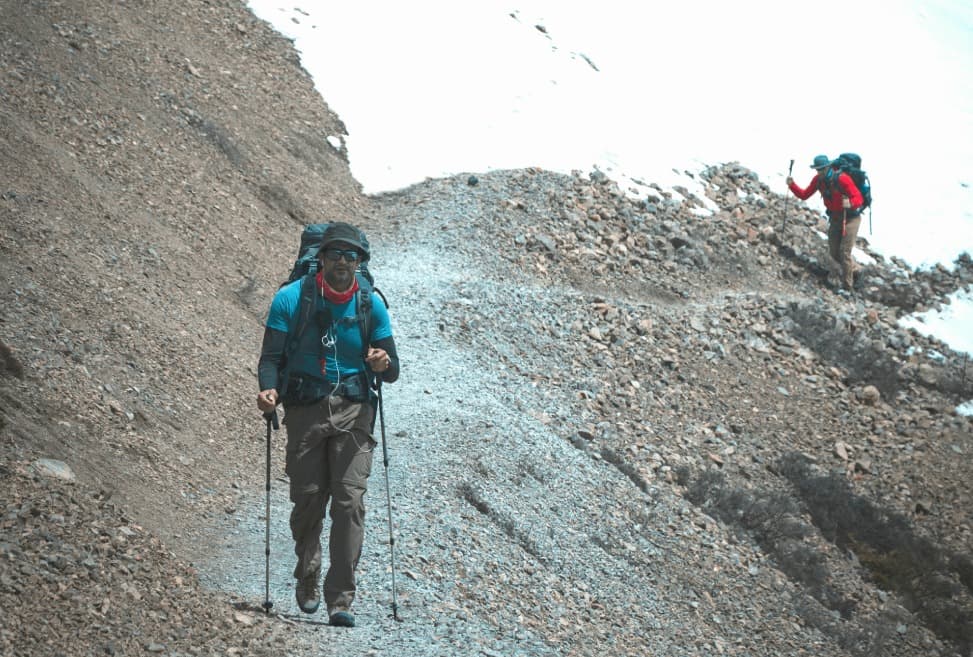
The Ice Lake hike from Bhraka or Manang climbs roughly 1,000m to a glacial lake at 4,620m — a serious seven-to-nine-hour day, and one of the finest acclimatisation hikes on the entire circuit ahead of Thorong La. Gangapurna Lake offers a gentler alternative, a short walk from Manang town beneath a hanging glacier. Tilicho Lake, at 4,919m, is the more significant undertaking — roughly 21km one way, typically two days round trip on foot, with horseback able to shorten the lower stretch toward Khangsar.
It's long carried a reputation as the world's highest lake; in fact, nearby Kajin Sara, discovered near Chame in 2019, now holds that distinction — a detail that tends to surprise even well-travelled clients. Along any of these routes, you'll likely cross paths with Annapurna Circuit trekkers bound for Thorong La at 5,416m, and end up trading stories over tea.
When to Travel
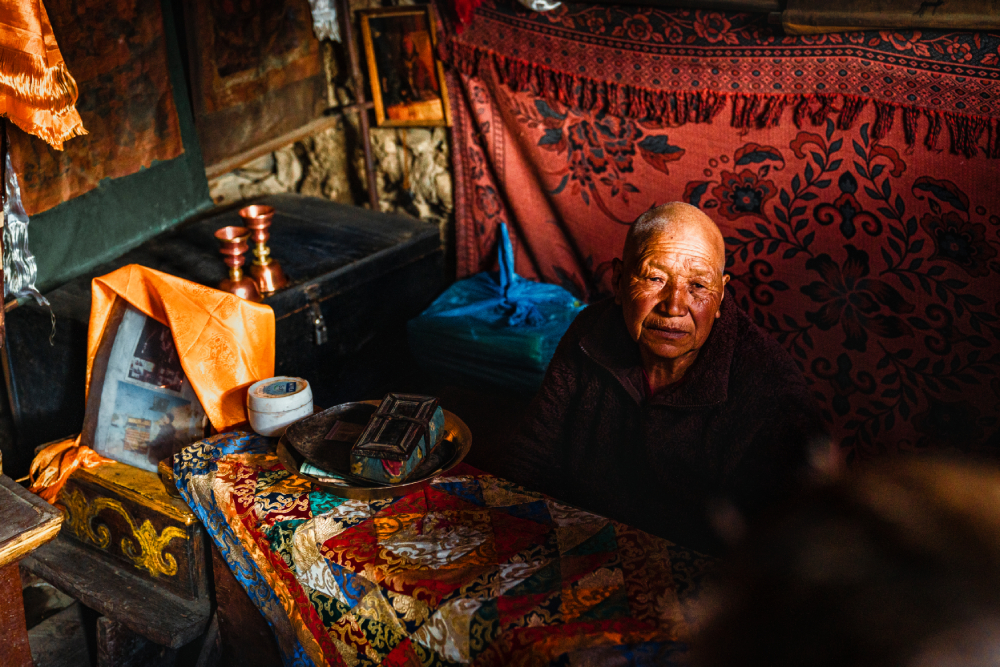
Spring (March–May) brings clear skies and rhododendrons in bloom — our most requested window. Autumn (mid-September–November) offers crisp air, apple season, and the most consistently reliable weather. December through February brings heavy snow and closes much of the valley; June through August carries monsoon landslide risk on the overland route.
If arriving by helicopter, we plan for clients to already be acclimatised, or build in a Chame stop first regardless of season.
Before You Travel
- Permits — handled entirely by our team ahead of your arrival
- Altitude — we plan at least two nights above 2,500m before any direct flight into Manang
- Packing — layered clothing, gloves for cold mornings, sunscreen
- Etiquette — quiet in the monasteries, and attentiveness to local custom matters more here than in most parts of Nepal
Questions We're Asked Most
Is it safe to fly directly into Manang without acclimatising first?
We don't recommend it without preparation. Flying skips the gradual elevation gain the overland route provides, so we build at least one rest day into every itinerary before any hiking begins — regardless of a client's fitness level.
Is the road to Manang fully paved?
Partially. Kathmandu to Besisahar is a smooth highway; Besisahar to Chame is a genuine mix of plastered and unsurfaced sections. Comfortable in a private 4WD with an experienced driver, though not a highway drive throughout.
Is a guide required to visit Manang?
Yes — within the Annapurna Conservation Area, a licensed guide or agency representative is now mandatory. Beyond the requirement, it's the difference between passing through the valley and actually understanding it.
Can I visit Manang without completing the full Annapurna Circuit?
Yes. A helicopter day trip or a shorter overland itinerary with a Chame stop both work well for clients without ten or more days available.
What does a private helicopter charter cost?
It varies by group size, season, and departure point. We'd rather quote your actual dates accurately than publish a figure that may no longer hold by the time you read this.
Is altitude sickness a genuine concern in Manang?
At 3,519m, yes — worth taking seriously regardless of route. It's why acclimatisation is built into every itinerary we design, whichever way you arrive.
Begin planning your journey to Manang →
Related:
- Annapurna Circuit vs. Annapurna Base Camp: Which One Is Right for You?
- 7 Best Luxury Journeys in Nepal