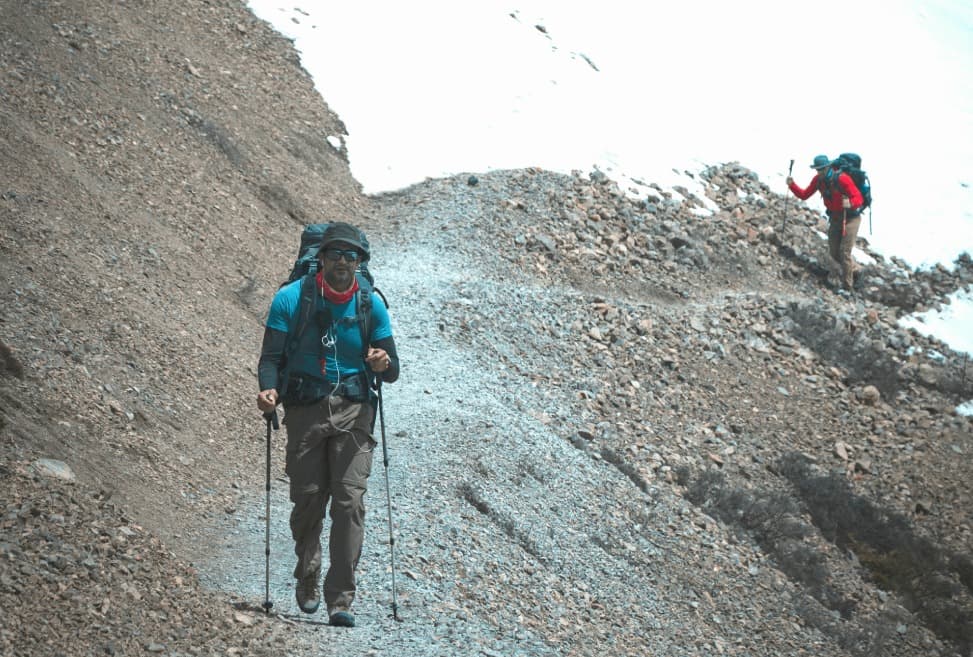
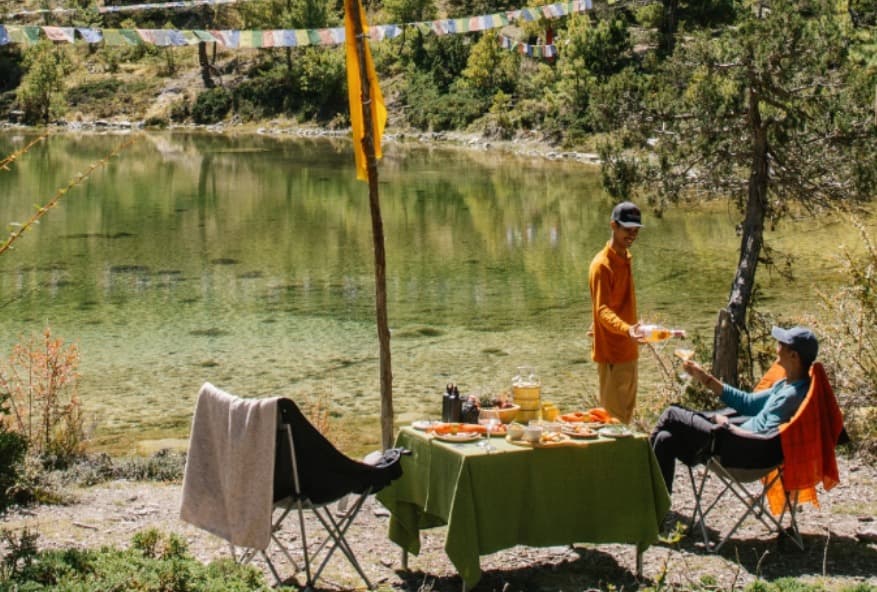
I did not know about Tingtibi until I went there.
That sentence is the most honest endorsement I can give any destination. I have been running luxury journeys through Nepal and Bhutan for twenty years. I think I have seen most of what these countries offer. Tingtibi stopped me.
It sits in southern Bhutan, in the Zhemgang district — Bhutan's designated ecotourism capital — on the banks of the Manas River, inside a forest that has been left almost entirely alone. Five kilometres of off-road track separate it from the nearest town. When you arrive, the isolation makes immediate, complete sense.
This is not Tingtibi as a footnote in a birding itinerary. This is Tingtibi as a destination in its own right — for wildlife travelers, conservation travelers, birdwatchers, and anyone who has run out of ways to describe what they are looking for except to say: something real, somewhere almost nobody else has been.
The eco-lodge of Tingtibi— luxury in the wild, not luxury instead of it
There are five cottages on the property of Berti Eco Lodge. Each has its own balcony. The river is always audible — the Manas River running alongside the lodge, constant and unhurried, setting the pace for everything else.
The standard is clean and comfortable — close to a three-star level, built well and maintained carefully. This is not Six Senses. There is no pretence of that. What the lodge offers instead is something Six Senses cannot: genuine immersion in a forest that does not know you are there. The wildlife outside your door does not perform for guests. The birds arrive on their own schedule. The Golden Langur in the trees above the lodge appear when they choose to, not when a guide has arranged their appearance.
Inside the lodge grounds, something unusual: Golden Mahseer fish move through the water channels that run alongside the property. They are part of the ecosystem, not an exhibit. When I visited, a natural swimming pool was being constructed directly beside the river — the water drawn from the river itself, the structure built to sit inside the landscape rather than impose on it.
The lodge is managed by six women from the local Tingtibi community, trained and supported by the Zhemgang District Administration. They run every aspect of the operation. They employ local men for maintenance and construction work. These are not people performing community involvement for tourism marketing purposes — they built a livelihood here. You feel the difference when you arrive. There is an ownership to the place, a quiet pride, that changes how the whole experience feels.
The Golden Langur — one of the rarest primates on earth
The Golden Langur is found in two places on earth: the Assam region of India and Bhutan's Zhemgang district. Bhutan's population is, by most accounts, the healthier and larger of the two.
I saw them on my first morning at the lodge.
Around 10 am, movement started in the trees above the property. The group appeared gradually — twelve to fifteen individuals, working their way through the upper branches, feeding on fruit. They are naturally shy animals. Here, in an area where the government has actively protected their habitat and ensured food availability, they feel safe enough to remain visible rather than retreating.
The distance was close enough to observe clearly, far enough to feel appropriate. They watched us with the kind of calm intelligence that reminds you very clearly that you are the visitor.
This is not a guaranteed sighting. That is what makes it real. What I can tell you is that the conditions here — the protected habitat, the food sources, the absence of heavy tourist traffic — make a sighting more likely than almost anywhere else in Bhutan.
The Great Hornbill and Tingtibi's extraordinary birdlife
I have spent significant time in Nepal's jungles for over twenty years. I had never seen hornbills like this — not in that number, not that close.
The Great Hornbill is the flagship species, but Tingtibi's forest holds considerably more. The Rufous-necked Hornbill. The Wreathed Hornbill. The Ward's Trogon. The Beautiful Nuthatch. The Blue-bearded Bee-eater. The White-bellied Heron is one of the most critically endangered birds in Asia, with only a handful of confirmed individuals remaining. Species after species that I kept photographing simply to identify later, because the forest there holds things I had not encountered anywhere else.
Zhemgang district has recorded over 500 bird species. The Tingtibi area, specifically — with its subtropical broadleaf forest at low altitude along the Manas River — is considered one of the premier birding hotspots in Bhutan. Serious birdwatchers come specifically to this region. The Zhemgang Bird Festival in November draws birding groups from across the world and is timed precisely because this is when the forest is most alive and most visible.
The forest does not need to be arranged for you. You walk into it, and it is simply there, exactly as it is.
The Golden Mahseer conservation program in Tingtibi's Eco Lodge
The Golden Mahseer is called the tiger of the Himalayan rivers. It is among the most endangered freshwater fish in the world.
The near-extinction of the Mahseer in Bhutan's rivers was caused by dam construction that disrupted the river systems they depended on. WWF intervened. The dams that would have finished the process were stopped. A conservation program was established, run by the Zhemgang District Administration with the direct involvement of local communities.
The juvenile Mahseer are raised in controlled water channels — a structure similar in principle to a traditional raajkulo system, where water flows naturally through a managed channel connected to the main river. The fish are not trapped. They grow in a semi-natural environment with the current and the water quality of the river itself flowing through it. When they reach the appropriate size, they move into the Manas River on their own — there is no theatrical release moment, no ceremony staged for cameras.
What guests witness is the transition phase: juveniles visible in the channels, growing toward the river that is waiting for them. You understand where they are going. You understand what it costs to get them to this point. That context — the near-extinction, the intervention, the patient work of the community — is part of what you carry away from Tingtibi.
What you actually do in Tingtibi to explore Wildlife
Tingtibi is not about a structured activity schedule. It is about immersion in a place that operates at its own pace.
Dawn and dusk walks along the river are where the birdlife is most active. Early mornings on the balcony with the river below and the forest waking up around you are not incidental — they are the product.
Jungle walks with a local naturalist guide take you into the forest itself. Each walk is different depending on conditions, season, and what the forest is doing that day. This is not a managed nature walk with guaranteed sightings at predetermined points. It is a walk in a forest that has its own agenda.
The Manas River offers white water rafting when conditions allow — the river runs fast and clear in the right season, and the surrounding landscape from the water is completely different from anything visible on foot.
Community visits to Tingtibi town connect you with the Khengpa people, whose culture and traditions have been maintained in this remote district with remarkable continuity. These are not curated cultural performances. The town exists for the people who live there, and visiting it with the right guide means entering that life briefly and with genuine respect.
When to go — the two seasons that work best
November is the strongest window. The Zhemgang Bird Festival takes place in November, timed precisely because this is peak season for birdlife in the region. The forest has shed its monsoon density, the skies are clear, temperatures are comfortable, and bird activity is at its highest. For serious birdwatchers, November in Tingtibi is non-negotiable.
September is the other compelling option, and one that most operators do not recommend because it requires understanding why the timing works. September is when the monsoon is retreating, but has not yet fully withdrawn. The forest is at its most alive — dense, productive, full of fruiting trees that draw the Golden Langur and the hornbills into active, visible feeding. Water sources are full and active. The Mahseer in the river channels are visible and vigorous. And crucially: almost nobody else is there. The birdwatching groups come in November. September visitors have the entire forest essentially to themselves, with wildlife activity that rivals the festival season at a fraction of the human traffic.
The monsoon itself makes road access unpredictable and the experience uncomfortable. From June to August, we do not recommend. December onwards, the forest quiets and wildlife disperses.
Getting to Tingtibi — the journey into isolation
The journey begins in western Bhutan — most Tingtibi visits are incorporated into a broader Bhutan itinerary starting in Paro or Thimphu.
The road to Tingtibi town is fully paved and accessible to standard vehicles. The drive from Gangtey takes approximately six hours through some of Bhutan's most dramatic mountain scenery — the road descends from the high altitude of the western valleys through forest and farmland into the subtropical south. From Punakha or Gangtey, we recommend switching to a 4WD for the onward journey.
The final five kilometres from Tingtibi town to the lodge is off-road. The track is rough. It is also the final signal that you are arriving somewhere genuinely apart from everything else.
Who this experience is for
Tingtibi is right for wildlife travellers who have done the standard safari circuits and want something that cannot be replicated on another continent.
The combination of endemic species — Golden Langur found nowhere else on earth at this scale, the Golden Mahseer found in almost no other river system — gives Tingtibi a specificity that East Africa or Borneo cannot offer.
It is right for serious birdwatchers and birding group operators looking for a Bhutan experience anchored to genuine wildlife substance rather than scenic touring with occasional bird stops.
It is right for conservation-minded luxury travellers who want the experience of witnessing a real program in action — not a donation mechanism attached to a hotel, but a community-run conservation effort you can stand inside and understand.
And it is right for any traveller who has found that the most memorable moments of their travel life happened in places that were not on the standard list. Tingtibi is not on the standard list.
Practical details
Duration: Tingtibi works best as a two to three-night stay, incorporated into a broader Bhutan itinerary of seven to fourteen days. It can be the final section of a journey that begins in Paro and moves eastward and south, or it can anchor a wildlife-focused Bhutan trip with Royal Manas National Park as a natural extension.
Accommodation: Five cottages, each with a private balcony and a river-facing aspect. Managed by local women from the Tingtibi community. Meals prepared using local produce. Standard comparable to a clean, well-maintained three-star lodge — genuinely comfortable, not artificially polished.
Getting there: 4WD vehicle required for the final approach. We arrange all ground transport as part of the full itinerary.
Bhutan entry requirements: All visitors to Bhutan pay the Sustainable Development Fee — currently $100 per person per night— which funds free healthcare and education for every Bhutanese citizen. We include the full cost breakdown from the first conversation. No hidden costs.
Best combined with: Royal Manas National Park (one to two days further south), Zhemgang Dzong and the heritage village of Trong, the hot springs at Gomphu. For a fuller Bhutan circuit, the journey from Thimphu and Punakha through Trongsa to Tingtibi is one of the most varied and underused routes in the country.
Frequently asked questions
Is Tingtibi suitable for non-birdwatchers?
Yes. The birding credentials are extraordinary, but they are not the whole experience. The Golden Langur, the Mahseer program, the community story, the river, the forest — these are compelling for any traveller interested in wildlife and conservation, regardless of whether they carry a field guide.
Is accommodation genuinely comfortable?
It is clean, well-maintained, and genuine. It is not a luxury resort in the traditional sense. We describe it as luxury in the wild — comfortable enough to be a proper base, remote enough that the surrounding environment is always the dominant experience.
Can it be visited as a day trip?
Technically possible from Trongsa or Zhemgang town. We do not recommend it. The experience at Tingtibi is fundamentally about the early mornings and the evenings — dawn birdwatching and dusk wildlife activity that require being there overnight.
What is the best way to incorporate Tingtibi into a Bhutan itinerary?
Most effectively as the final two to three nights of a standard western Bhutan circuit (Paro, Thimphu, Punakha, Gangtey, Trongsa, then south to Tingtibi). This allows the traveller to move from the high cultural circuit of Bhutan into the wild south — a contrast that makes both experiences more vivid.
Is this suitable for a combined Nepal-Bhutan journey?
Perfectly. The combined journey we design most frequently moves through Nepal's Annapurna Heritage Trail and Kathmandu, then into Bhutan for the cultural circuit, followed by Tingtibi as the final immersive wildlife section. The arc from Nepal's mountain culture through Bhutan's spiritual heartland to this specific, protected corner of wild southern Bhutan is one of the most complete journeys we offer.
Interested in Tingtibi? This is not a standard booking. Contact us directly and tell us what you are looking for. We will tell you honestly whether this experience is right for you — and if it is, we will build the rest of the journey around it.