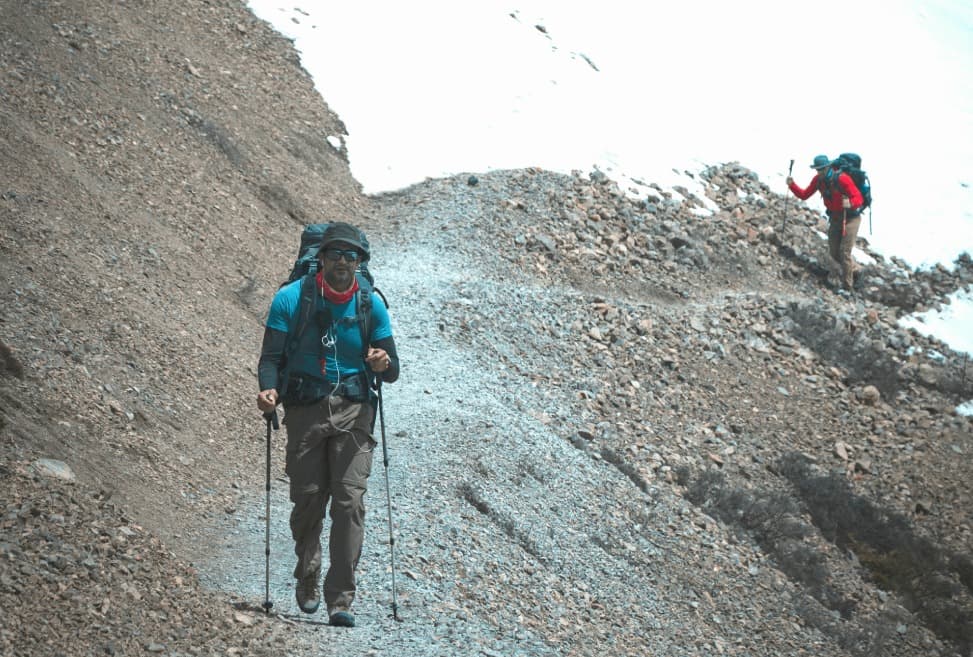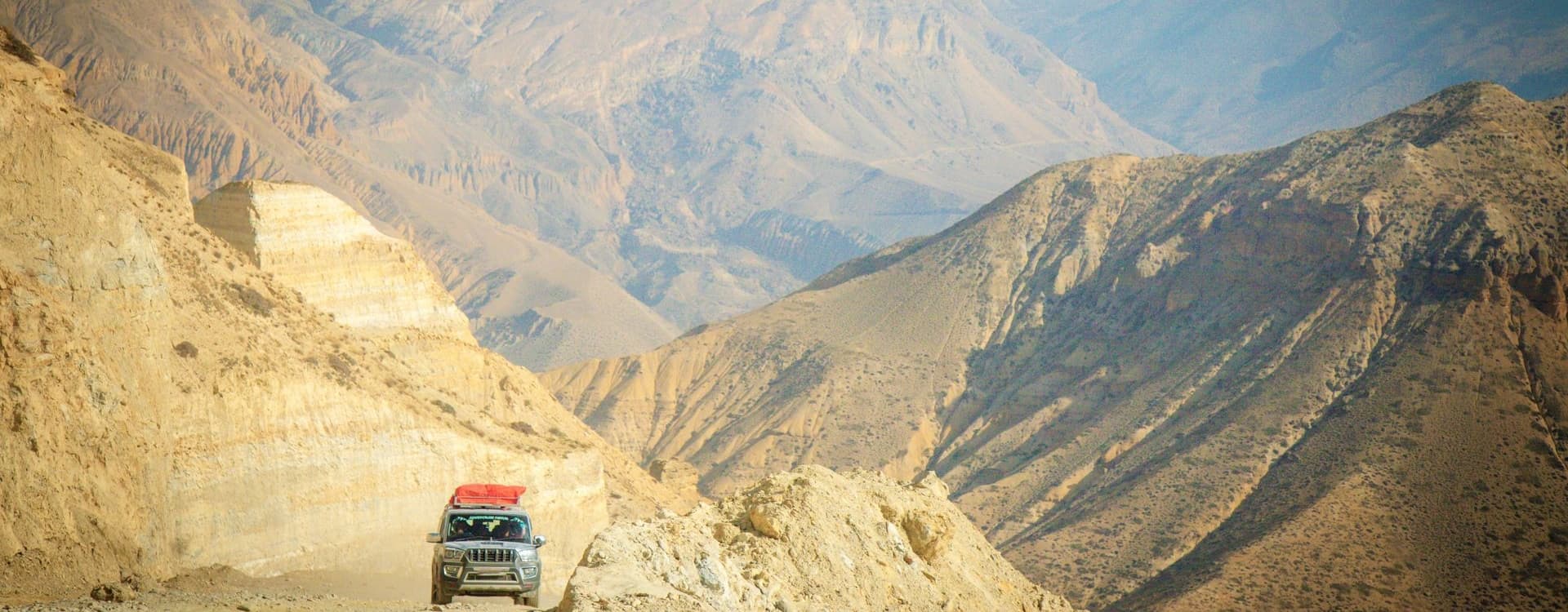
There's an assumption baked into how people think about Himalayan travel: if you're not walking, you're sightseeing. If you're in a vehicle, you're skipping the real thing. Comfort means shallowness. Distance means you're missing what matters.
Upper Mustang destroys this idea entirely.
I've driven into the last forbidden kingdom in the high desert, and I've also trekked into it. The jeep version isn't a compromise for people with weak knees or tight schedules. It's a deliberate choice for people who want to spend more time inside the place itself — fewer hours moving between point A and point B, more hours standing in a monastery courtyard while a monk reads prayers in silence, more afternoons walking through Lo Manthang's walled city without an endpoint, more moments of just sitting with what Mustang actually is.
The trekking version has its own rightness. But if you're trying to move the needle on depth rather than difficulty, the jeep offers something trekking fundamentally cannot: freedom to linger.
What a Jeep Day Actually Looks Like
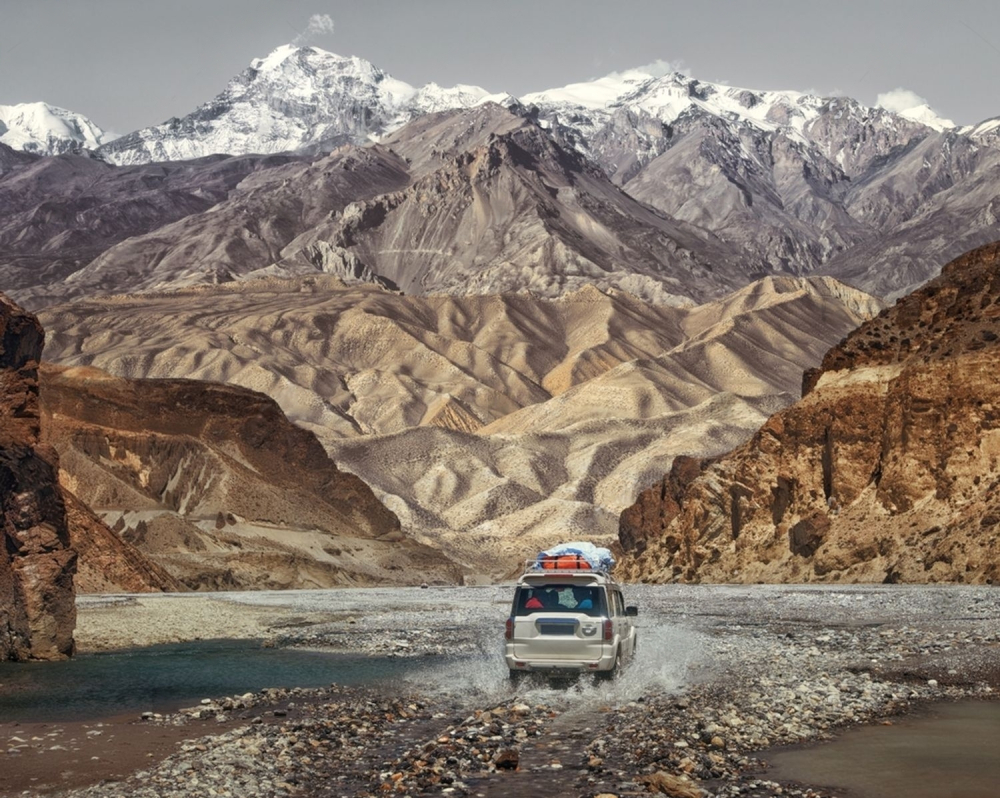
The 12-day Upper Mustang Jeep Tour from Pokhara follows a deliberate rhythm. Days 1–4 are the drive in: from Pokhara through the Kali Gandaki Valley (Marpha, with its apple orchards and Thakali monasteries), then Kagbeni at the gateway to Upper Mustang, then the switchbacks up to Dhakmar and the red cliffs that announce you've entered something ancient.
By Day 5, you're in Lo Manthang — the walled city. And this is where jeep access reveals its hidden advantage.
On a trekking itinerary into Upper Mustang, you arrive exhausted. Your legs have carried you through thin air at altitude. Your body needs recovery. You check into your lodge, eat, and sleep. The next morning, you explore Lo Manthang — perhaps the Chhoede Monastery with its old murals, perhaps the royal palace. But you're moving deliberately, cautiously, because you have another multi-hour walk to somewhere else later that day or the following day. The destination is behind you. You're already thinking about the next stage.
On the jeep version, you arrive rested. Your body knows what comfortable looks like. That first afternoon in Lo Manthang, you have the mental and physical space to simply walk. No schedule pushing you toward the next camp. No calculation of how many hours of daylight remain before you need to reach shelter.
The difference is quiet, but it's structural.
Day 7 on our itinerary sends you to Chhoser — the village of the sky caves, five-story cliff dwellings carved into stone centuries ago. But instead of trekking there, you drive. You arrive and step out into a landscape that feels unmade by human logic. The caves are still above you, still requiring a walk to enter, still demanding the slow approach that reverence requires. But you've saved the hours of footfall. You use that time inside the caves differently. You sit. You ask questions of the guide. You listen to what monks say when no one's hurrying them.
Then you drive to the Korala Border — Nepal's northernmost point, the border with Tibet, 4,660 meters. On a trek, reaching this would be a summit day achievement. On a jeep, it's an afternoon excursion. You see it not as a conquest, but as a place. A place where wind moves in ways it doesn't anywhere else. Where the border is real, tangible, and you can stand at it without the fog of exhaustion between you and what you're seeing.
Why Mustang's Exclusivity Isn't About the Difficulty of Arrival
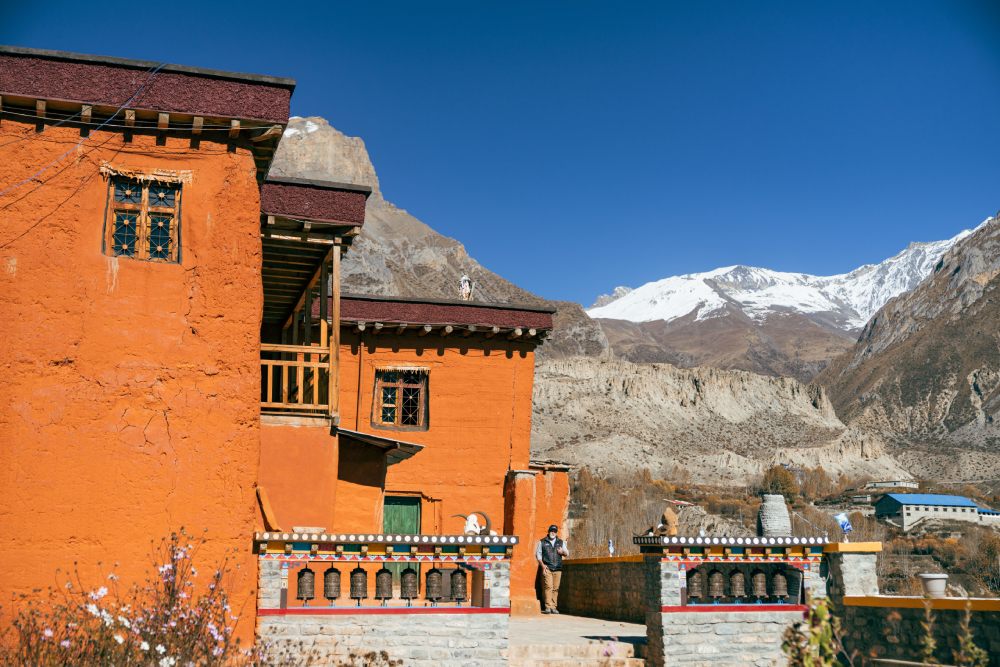
Mustang was closed to outsiders until 1992. The Restricted Area Permit now costs $50 USD per day—flexible whether you stay 10 days or longer—and the region has opened to solo travellers, provided you're accompanied by a licensed guide. This structure doesn't exist because the government wants to monetise access. It exists because Mustang has something fragile to protect. A living Tibetan culture inside Nepal. Monasteries that predate the modern state. A walled city where daily life hasn't been reorganised for tourism.
The exclusivity is real. But it has nothing to do with whether you got there on foot or in a vehicle.
The permit requires a licensed guide—not to enforce suffering, but to ensure you move through the region with respect. To ensure you're not photographing monks without permission, not entering sacred spaces as though they're museum exhibits, not treating villages as stage sets for your adventure narrative.
A guide brief is the same whether you trekked or drove. The villages are the same. The monasteries are the same. The Tibetan families in Ghami, Dhakmar, and Lo Manthang don't experience tourists differently based on their mode of transport. What they notice is attention. They notice whether you asked permission. Whether you're present or taking pictures to document presence.
The jeep changes how you spend time, not whether you're allowed to be there.
Who This Actually Suits
There's a particular traveller this works for, and I'd rather name them honestly than pretend the jeep version is better for everyone.
First: experienced trekkers who've already moved through the Everest region, Annapurna, Langtang. These are people whose bodies know what altitude feels like. They're not new to Nepal. They come back because something in the culture or the landscape drew them again — not because they need to climb another mountain or tick another valley off a list. For them, Mustang by jeep means: I'm returning to the Himalayas not to test my endurance, but to spend time in a place that matters. That's a fundamentally different intention.
Second: travellers over 60, or those with existing joint issues, or people whose idea of luxury isn't hotels but logistics that enable lingering. A six-day multi-stage trek at altitude isn't actually restful, even with a comfortable lodge waiting each night. The jeep removes that conflict. You experience the place without your body reminding you every step that you're compensating for something.
Third: anyone whose time is genuinely constrained. The 12-day itinerary compresses what would otherwise require 18 or more days on foot. If you have a week and a half and you want to see Mustang deeply, the jeep is how you do it.
Fourth — and this might sound odd — partners or small groups where not everyone has the same physical capacity. If one person is an experienced trekker and the other isn't, the jeep itinerary lets you both be in the same place at the same depth. You're not splitting the experience.
None of these is a failure of character. They're just facts about who people are and what they need.
Jeep vs. Trek: Which Route Saves You More Time in Upper Mustang?
| Metric | Jeep Tour (12 days) | Trekking (18–20+ days) |
|---|---|---|
| Total Duration | 12 days | 18–20+ days |
| Daily Walking/Driving | 15–18 hours total (spread across 12 days) | 50–60 hours walking over 10–12 trekking days |
| Average Hours Per Day | 1.5–2 hours driving | 5–7 hours walking |
| Time at Destination | Significantly more—arrive rested, can linger | Less—arrive fatigued, must move forward |
| Lo Manthang Exploration | 2–3 full days to wander, sit, engage | 1–2 days before next stage begins |
| Chhoser Sky Caves Visit | Afternoon excursion (easy access) | Full day's walk, requires stamina |
| Korala Border (4,660m) | Day trip from Lo Manthang | Multi-day trek or not reached |
| Village Immersion | Unhurried, flexible pacing | Time-constrained, schedule-driven |
| Physical Recovery | At comfortable lodges each night | Basic guesthouses, body still processing altitude |
| Body State Upon Arrival | Rested, alert, ready to engage | Exhausted, needing food and sleep first |
| Permit Cost | $50/day × 12 = $600 total | $50/day × 18–20 = $900–1,000 total |
The numbers are stark. A trekking itinerary eats 40+ hours just getting between places. On the jeep version, you've reclaimed those hours. What you do with them isn't structured—it's not "Lama interview at 3 pm, meditation walk at 4 pm." It's whatever emerges when your body isn't demanding rest and your mind isn't calculating time.
Most of our clients don't schedule their reclaimed time. They use it to sit in a monastery. To drink butter tea with a family in a village. To walk alone through Dhakmar without a guide talking, without an endpoint, without a schedule that says "we need to move on."
That's the depth the jeep enables. Not laziness. Not avoidance of the destination. The opposite: more time to let the place work on you without your body intercepting the message.
Ready to see the difference? Book your Mustang jeep tour →
The Comfort Question, Reframed
"Luxury" in Mustang doesn't mean marble or thread count. The lodge in Lo Manthang is called The Royal Mustang Resort, and it's genuinely comfortable — you have hot water, electricity, mattresses that support sleep. But it's not opulent. It's not trying to be. The point of these stays is that you recover well enough to return to what you came for: the place itself.
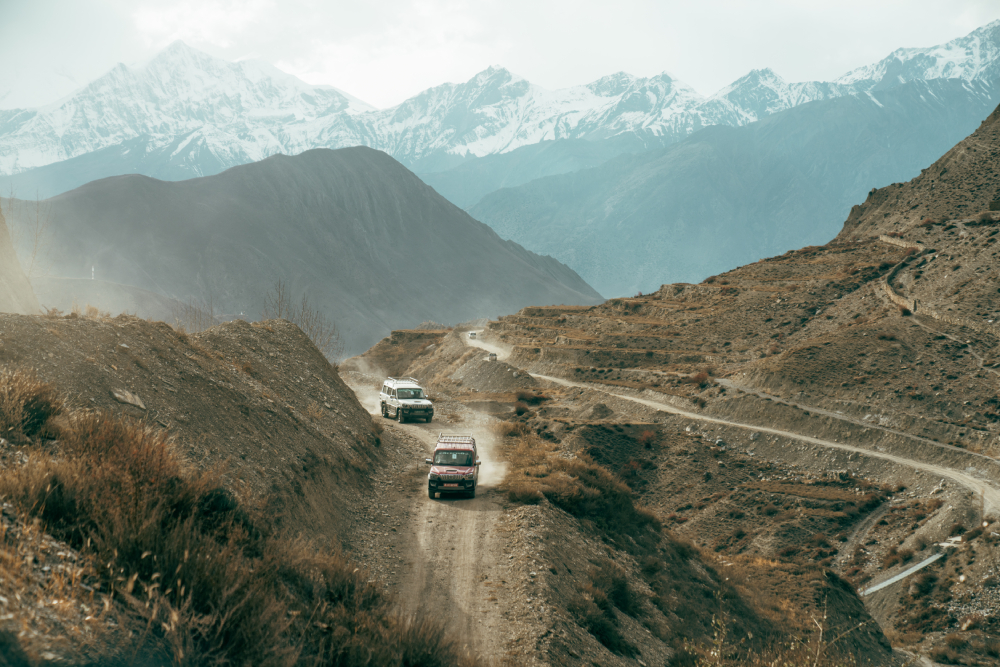
The jeep is the same principle applied to transport. You're not flying in a helicopter or being shuttled in an air-conditioned coach oblivious to landscape. You're travelling by 4WD, by the same route trekkers walk, seeing what they see, moving at a pace that lets you actually look. The difference is that at the end of the day, your knees don't hurt. Your hips aren't strained. Your mind isn't preoccupied with the next 20 kilometres.
Comfort here isn't about avoiding the journey. It's about enabling it.
Why Luxury Mustang Tours Choose Jeep Access Over Helicopter Flights
There are operators who fly clients into Upper Mustang by helicopter. It's faster, more obviously luxurious, more expensive. We don't do that. Not because we can't, but because it breaks what Mustang actually is.
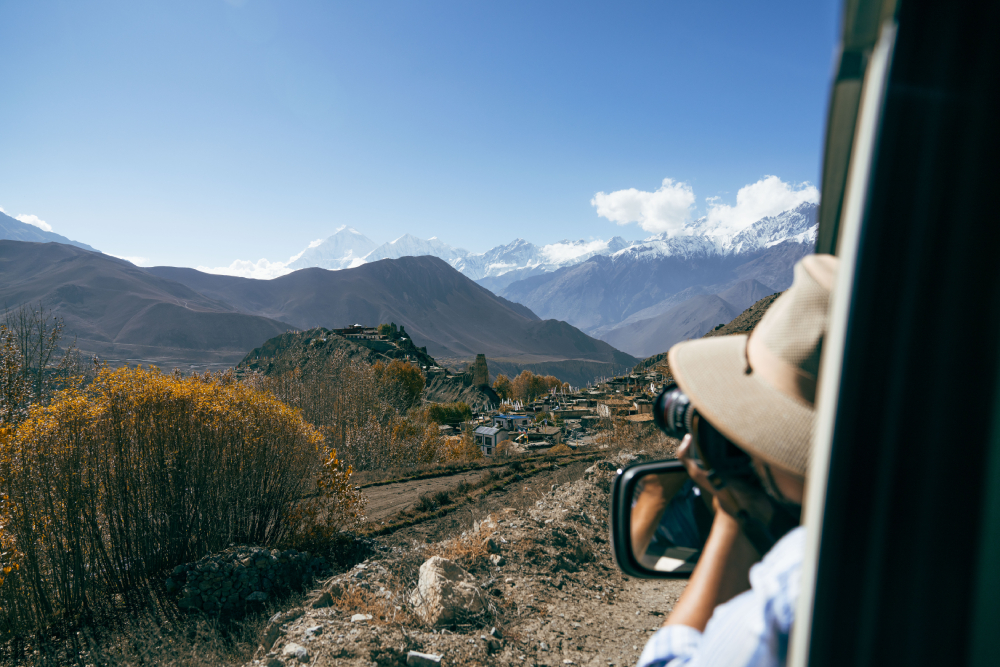
A helicopter lands you outside the system. You see the landscape from above, from a distance. You arrive as an outsider looking in. A jeep lands you inside—on the same roads locals use, moving at a pace that lets you see details: prayer flags hung from cliff edges, children playing in courtyards, the weathering of monastery walls. A helicopter is about the view. A jeep is about belonging, briefly, to the place.
Luxury at altitude isn't about speed or spectacular access. It's about comfort that enables presence. The jeep does that. The helicopter does the opposite. It's the difference between seeing Mustang and being in Mustang.
Interested in learning more about how we approach this? Get in touch →
FAQS
Q: Can you visit Upper Mustang without trekking?
A: Yes. The Upper Mustang Jeep Tour allows visitors to explore the region by 4WD vehicle. This approach reaches the same villages, monasteries, and sites as a trekking itinerary—including Lo Manthang, Chhoser sky caves, and the Korala Border—but with significantly less walking. A jeep itinerary is 12 days, versus 18+ days on foot.
Q: Is Upper Mustang accessible by jeep?
A: Yes. The main route into Upper Mustang—from Pokhara through Kagbeni and Dhakmar to Lo Manthang—is drivable by 4WD. The road is rough in places and altitude is significant (up to 4,660m), but the journey is regularly completed by jeep-based tours.
Q: How many days do you need for a Mustang jeep tour?
A: A minimum of 10–12 days is recommended for a full Mustang experience by jeep. This allows time for acclimatisation, exploration of Lo Manthang and its monasteries, visits to villages like Ghami and Dhakmar, and a day trip to the sky caves at Chhoser and the Korala Border. Some travellers extend to 15+ days to trek certain areas around the main route.
Q: Do you need a special permit for Upper Mustang?
A: Yes. Two permits are required: the Restricted Area Permit (RAP) at USD $50 per person per day (flexible for any length of stay), and the Annapurna Conservation Area Permit (ACAP) at USD $30 per person. A licensed guide is mandatory—this applies to all travellers, including solo visitors—and is arranged as part of any jeep tour package.
Q: Is jeep touring Upper Mustang still a luxury experience?
A: Yes. The jeep itinerary includes 5-star accommodation in Kathmandu and Pokhara, comfortable lodges in Marpha, Ghami, and Lo Manthang (The Royal Mustang Resort), and all meals. The experience prioritises comfort and time spent in place—not removing you from the destination, but enabling deeper engagement with it.
Q: What is the difference between trekking and jeep touring Upper Mustang?
A: Both reach the same destinations. The trekking version typically requires 18+ days, involves 5–7 hours of walking daily, and demands physical stamina. The jeep version takes 12 days, involves 15–18 hours of driving total (spread across the itinerary), and allows more time for deep exploration of villages, monasteries, and cultural immersion without fatigue. Choose trekking if you prioritise the journey itself; choose jeep if you want to maximise time spent inside the places that matter.
Q: Is the jeep route to Upper Mustang difficult?
A: The route is high-altitude (topping at 4,660m), and the roads are rough in places, but the vehicle does the work. Altitude effects are the main challenge; acclimatisation is managed by pacing the ascent over several days. This is typically easier on the body than a multi-day trek at altitude.
Q: What's the best time of year for a Mustang jeep tour?
A: Spring (March–May) and autumn (September–November) are ideal. These periods offer clear skies, stable weather, comfortable temperatures, and minimal risk of snow or heavy rain. Winter and monsoon season can make roads treacherous; mid-summer can bring cloud cover.
Q: Why do you choose jeep access over helicopter flights to Mustang?
A: A helicopter lands you outside the system—you see the landscape from altitude, arriving as an outsider. A jeep lands you inside, on the same roads locals use, moving at a pace that lets you notice details: prayer flags, children in courtyards, the weathering of monastery walls. Luxury at altitude isn't about speed or spectacular access; it's about comfort that enables presence. A jeep does that. A helicopter does the opposite. It's the difference between seeing Mustang and being in Mustang.
Conclusion
The jeep doesn't simplify Mustang. It doesn't reduce it or make it easier in any shallow sense. What it does is free you from the arithmetic of exhaustion—the constant calculation of distance, time, effort. It places you inside the kingdom rather than delivering you to it after a long march. You stand in Lo Manthang not because you've conquered the approach, but because you chose presence over endurance.
This matters because Mustang isn't a destination you reach and check off. It's a place that requires time to settle into your senses. The walled city reveals itself slowly. The monasteries ask for patience. The villages—Ghami, Dhakmar, Tsarang—open only to people who move through them without urgency, without the mental fog of physical depletion.
A 12-day jeep itinerary doesn't make you soft. It makes you available.
If you've trekked elsewhere in Nepal and want Mustang next, or if your body is no longer interested in proving things through distance, or if you simply value depth over difficulty, the Upper Mustang Jeep Tour is the rightness for you. You'll see the same sky caves. You'll sit in the same monasteries. You'll drink butter tea with the same families. The difference is that you'll do it rested, present, and without the clock.
Ready to experience Mustang at your own pace? Tell us your dates →