A client wrote to me in January asking a version of the same question I get most weeks now: "We've decided on Six Senses. Can you just tell us what the week actually looks like?" Not the pricing. Not another comparison against Amankora. She'd already done that reading. What she wanted was simpler and harder to find: what happens on Tuesday. What happens on Friday evening? Whether there's a moment built in to just sit still, or whether it's a week of being moved from one beautiful place to the next without ever landing anywhere.
That's what this page is for. If you're still choosing between lodges, our full pricing and lodge breakdown covers that ground properly, and our take on Amankora's circuit will help you see how it compares in temperament. This page assumes you've made that decision. You want to know what a real week looks like, day by day, and why it's built the way it is.
Why This Itinerary Only Uses Three of the Five Lodges
Six Senses Bhutan has five lodges. Most seven-day itineraries you'll find online try to visit all five, which means one or two nights in each, several long transfer days, and almost no time to actually settle anywhere before you're packing again.
We don't build trips that way. Bhutan doesn't reward speed. The valleys sit close together on a map, but they feel much further apart once you're moving between them. The things that actually stay with people, like a farmhouse dinner that runs three hours because nobody's watching the clock, or a monastery where a monk answers a question you didn't expect to ask out loud, need room in the schedule that a five-lodge circuit doesn't leave.
So this itinerary covers Paro, Thimphu, and Punakha across seven nights. Two nights of arrival and threshold in Paro, two nights of cultural grounding in Thimphu, and three nights in Punakha, where the trip actually opens up. Gangtey and Bumthang are extraordinary, and if you have more time or this isn't your first visit, they deserve their own week. For a first journey into Bhutan, I'd rather show you three valleys properly than rush you through five.
Day 1: Arrival in Paro, Drive to Thimphu
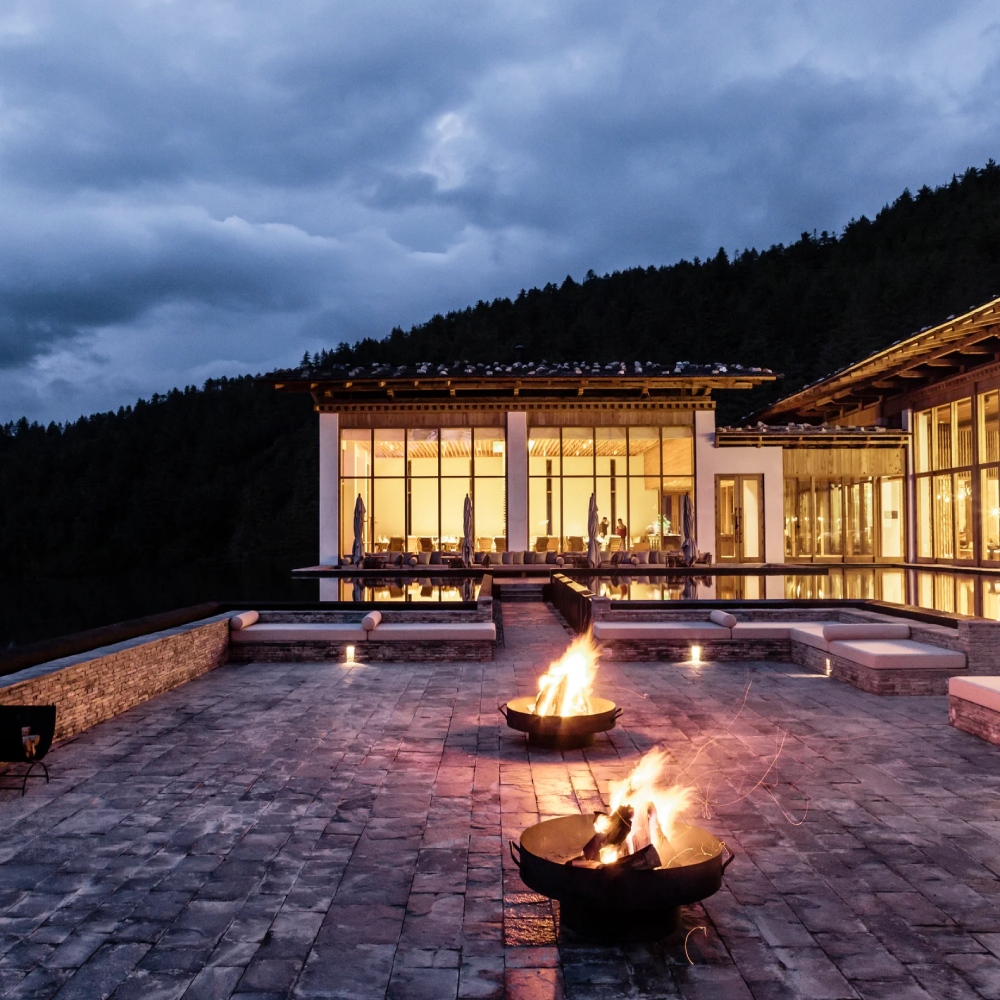
The descent into Paro is one of only a handful of approaches in the world where commercial pilots need special certification to fly it. The valley is narrow enough that the aircraft banks hard between ridgelines on final approach, low enough that you'll see individual farmhouses and terraced fields before the runway comes into view.
Paro sits at 2,200 metres. The drive to Thimphu climbs gently to just over 2,300 metres and takes about an hour along the Paro Chhu and then the Wang Chhu river valley. You'll pass Tachogang Lhakhang, a small iron bridge temple built by the 15th-century saint Thangtong Gyalpo, visible from the road on the right just before the valley opens toward the capital.
Thimphu itself has no traffic lights. The main intersection at Norzin Lam is run by a single officer in a raised octagonal booth, directing traffic by hand — the city tried an automated signal decades ago and pulled it out within a week because people found it impersonal.
Six Senses Thimphu, the Palace in the Sky, sits above the city on a forested hillside near Sangaygang, close to where Thimphu's own archery ground and the giant Buddha Dordenma statue are visible across the valley. Check-in typically includes a welcome tea of suja (butter tea) or ara, depending on the season, and a short orientation on the week ahead rather than a long briefing.
What's woven into today: the flight into Paro, a stop at Tachogang Lhakhang if timing allows, the drive to Thimphu, and an unhurried first evening.
Day 2: Explore Thimphu Deeper
The lodge's prayer pavilion sits slightly above the main buildings, facing east. Morning sessions here are usually 20 to 30 minutes, guided by the resident wellness host, and timed to finish as the sun clears the ridgeline.
The Choki Traditional Art School, founded in 1999, trains around 100 students at a time across a 6-year program in thangka painting, wood carving, and embroidery — all traditional arts protected under Bhutan's "Driglam Namzha" cultural code. Students work in open classrooms and mostly ignore visitors entirely, which is the point.
Cheri Monastery sits at the head of the Thimphu valley, reached by a 45-minute drive followed by a roughly 30-minute uphill walk across a footbridge over the Wang Chhu. It was built in 1620 by Zhabdrung Ngawang Namgyal, the unifier of Bhutan, and remains an active monastic school. Evening visits, timed after day-trippers have left, usually mean the sound of monks in mid-chant carries down the hillside before you reach the gate.
Back at the lodge, the pool and reflecting ponds sit at the same elevation as the guest rooms, roughly 2,400 metres, which makes the water noticeably cold most of the year — most guests use the heated infinity section instead.
What's woven into today: morning meditation, the Choki Art School, Cheri Monastery at dusk, and open time at the lodge.
Day 3: Drive to Punakha
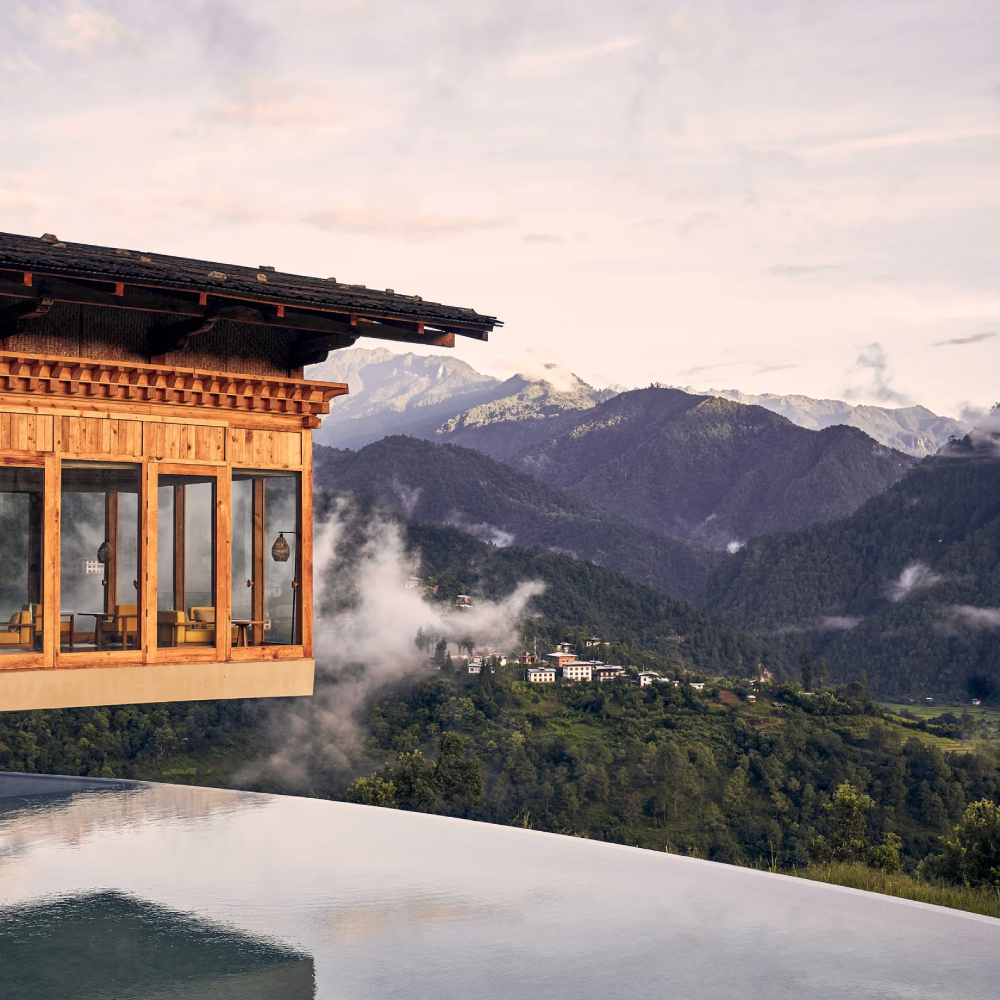
The road to Punakha climbs first, not down. You'll cross Dochula Pass at 3,100 metres, marked by the Druk Wangyal Chortens — 108 identical stupas built in 2005 to commemorate Bhutanese soldiers, arranged in a ring around the pass. On a clear day, this is the only place on the standard circuit where you can see the eastern Himalayan range properly, including Gangkhar Puensum, at 7,570 metres the highest unclimbed mountain in the world (Bhutan has banned mountaineering above 6,000 metres since 2003, largely on spiritual grounds).
From the pass, the road drops nearly 1,700 metres over nine winding kilometres, and the vegetation changes fast — pine gives way to rhododendron, then to banana and orange trees by the time you reach the valley floor at around 1,200 metres. Punakha is warm enough to grow citrus year-round, which is unusual this close to the high Himalaya.
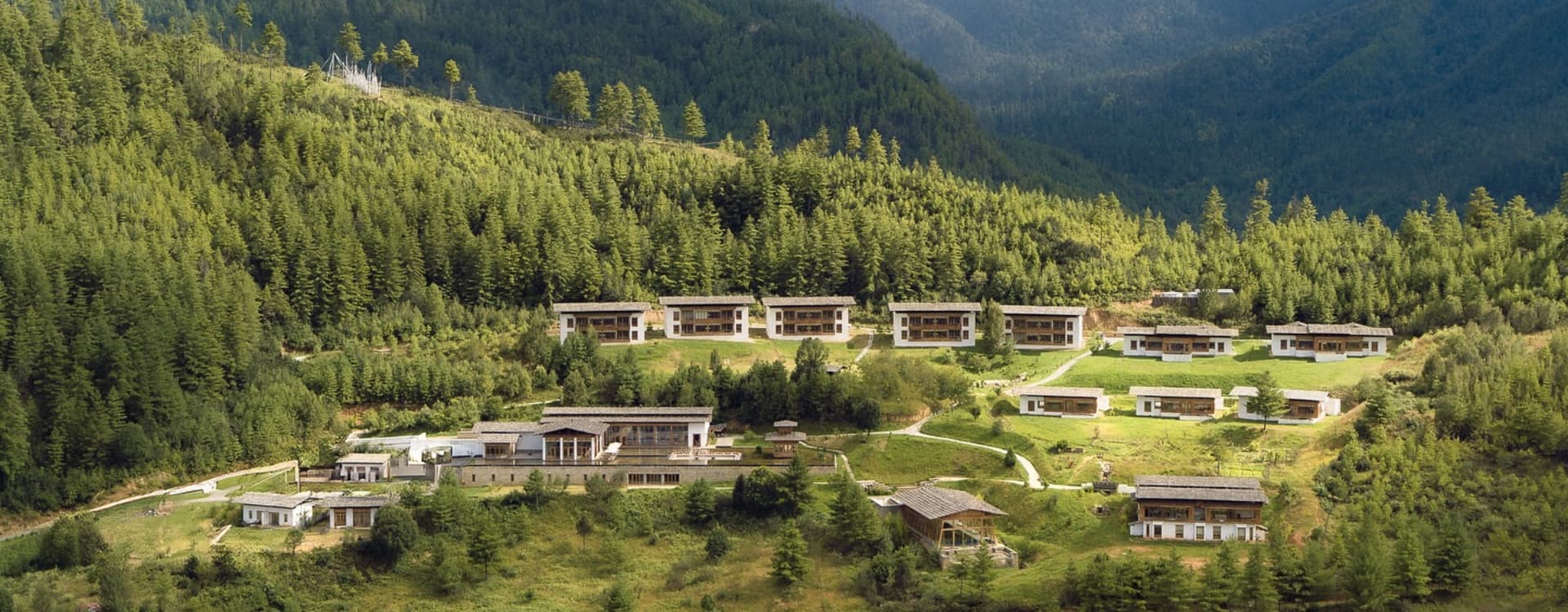
Six Senses Punakha, the Flying Farmhouse, is built into the hillside on stilts, echoing the raised timber-and-rammed-earth farmhouses still used in the valley below. Most guests arrive by mid-afternoon, with the rest of the day left open.
What's woven into today: Dochula Pass and the 108 chortens, the descent into the valley, and an unscheduled afternoon and evening.
Day 4: Punakha Deeper
Punakha Dzong sits at the confluence of the Pho Chhu (father river) and Mo Chhu (mother river) and was built in 1637–38 by Zhabdrung Ngawang Namgyal. It served as the capital of Bhutan until 1955 and is still where the King is formally crowned. The dzong has survived four major fires and an earthquake, and its inner courtyard holds a 108-foot-high utse (central tower) that most visitors underestimate from outside.
Chimi Lhakhang, the fertility temple, is reached on foot through Sopsokha village and its surrounding mustard fields, crossing one of the longest suspension bridges in Bhutan along the way. The temple was built in 1499 and is dedicated to Drukpa Kunley, the "Divine Madman" — a 15th-century saint known for using unconventional, often deliberately provocative teaching methods.
The farmhouse evening is arranged through a relationship with a specific family in the valley, built over repeat visits rather than a one-off booking. Expect ara (a home-distilled spirit, often served warm with egg or butter), red rice grown in the family's own paddies, and ema datshi, Bhutan's national dish of chilies and cheese, cooked at whatever heat level the household actually eats it at rather than a tourist-adjusted version.
What's woven into today: Punakha Dzong, the walk to Chimi Lhakhang, and a private farmhouse dinner.
Day 5: Drive to Paro, Easy Exploration
The return drive retraces Dochula Pass, roughly five to six hours total with stops, so this day is deliberately built as a soft landing rather than another full sightseeing day. Most itineraries either rush this transfer or waste it entirely; we split the difference with a short valley walk once you're back in Paro, timed for late afternoon light.
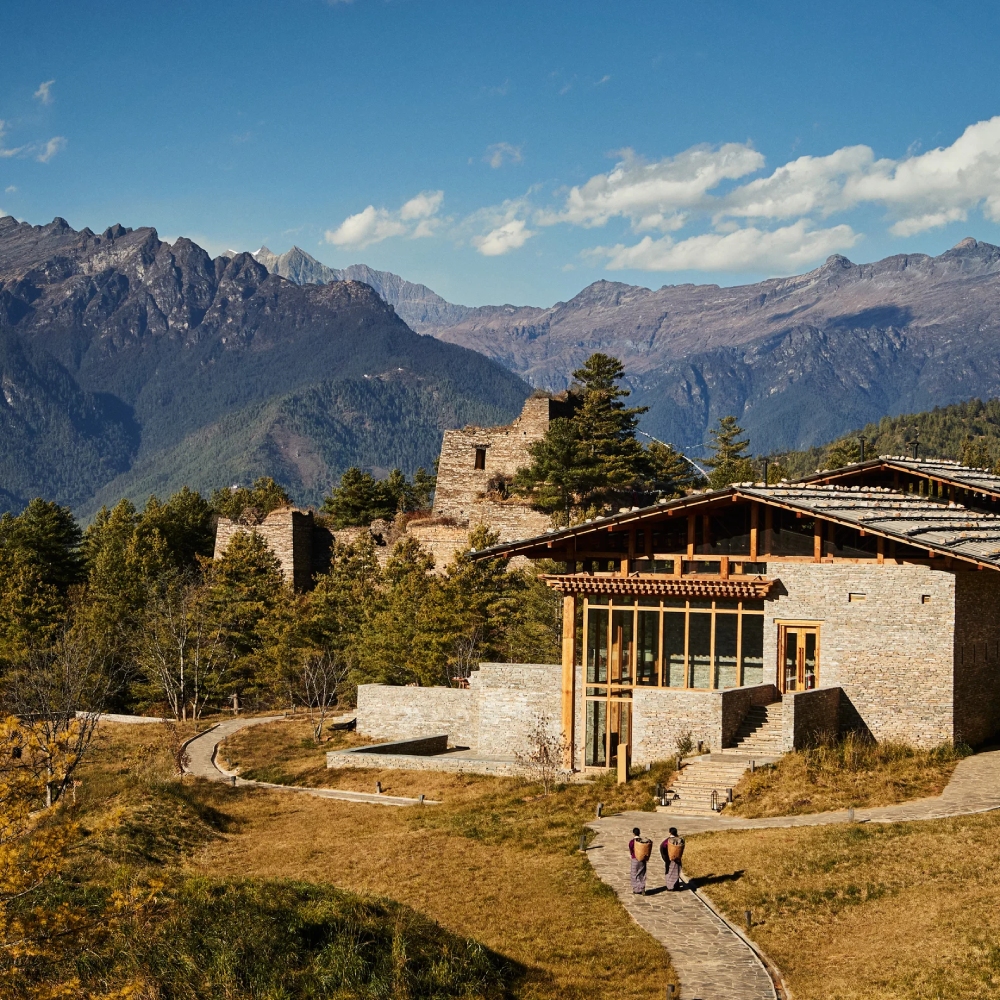
Six Senses Paro is built directly into the ruins the lodge is named for — the remains of a 15th-century watchtower once used to guard the valley approach. The stonework is original; the lodge was built around and into it rather than replacing it. At 2,200 metres, Paro sits lower than Thimphu, and the valley floor is wide enough that sunset light lingers longer here than in either of the other two.
Dinner among the ruins, weather permitting, is served under some of the darkest skies on the circuit — Paro has almost no ambient light pollution outside the town centre, and on a clear night the Milky Way is visible without any adjustment period for your eyes.
What's woven into today: the drive back through Dochula Pass, a short valley walk, and dinner among the ruins.
Day 6: Paro, Tiger's Nest Hike
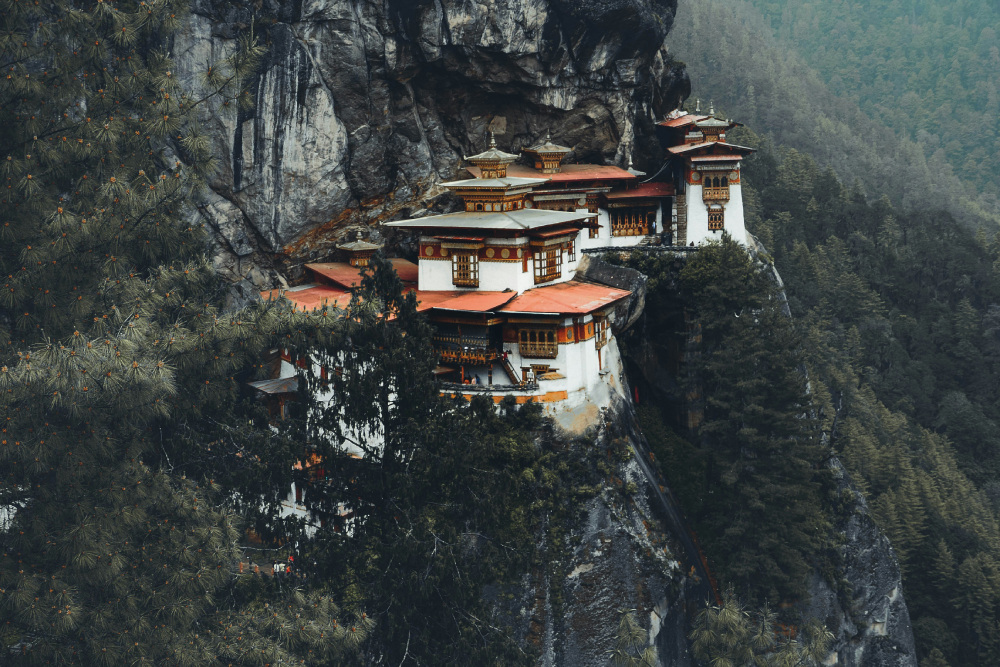
Taktsang Palphug Monastery clings to a cliff face 900 metres above the valley floor, at roughly 3,120 metres elevation. The climb is 4 to 5 kilometres each way and takes most guests two to four hours up, depending on pace and stops. The monastery itself dates to 1692, built around the cave where Guru Rinpoche is said to have meditated for three months after arriving on the back of a flying tigress in the 8th century — the complex now houses several temples cut directly into the rock.
There's a cafeteria roughly halfway up, around 2,600 metres, that makes a natural rest point and is where most guides recalibrate pace for the second half of the climb. Phub Tshering, who leads most of our Six Senses circuits, times this stop deliberately — not because the group needs it, but because it's the last place before the final, steepest section where a genuine break still feels natural rather than forced.
By day six, your body has had five days at altitudes between 1,200 and 3,100 metres to adjust, which makes a real difference on a climb that regularly defeats people attempting it on day one straight off a flight.
What's woven into today: the Tiger's Nest hike and spa recovery in the evening.
Day 7: Paro Deeper Exploration
Rinpung Dzong, built in 1646, is where Paro's annual tsechu festival is held each spring, and its wooden cantilever bridge, the Nemi Zam, is one of the last traditional covered bridges still in everyday use in the valley. The National Museum sits just above it in the Ta Dzong, a round watchtower built in 1649 specifically to defend Rinpung Dzong — it was converted to a museum in 1968 and holds Bhutan's largest collection of thangka paintings, ceremonial masks, and armour.
Kyichu Lhakhang, a short drive from town, is one of the oldest temples in Bhutan, said to have been built in 659 AD by the Tibetan king Songtsen Gampo as one of 108 temples built in a single day to pin down a giant demoness across the Himalayan region. Two 400-year-old orange trees grow in the courtyard and reportedly bear fruit year-round, an anomaly locals attribute to the site's sanctity.
The afternoon is left open by design. Most guests use it for the spa, treatments, or simply the pool, since day seven follows a physically demanding day six.
What's woven into today: Rinpung Dzong, Kyichu Lhakhang, the National Museum, and an open afternoon.
Day 8: Departure
Paro's airport handles almost all of Bhutan's commercial flights, and departures are concentrated in the morning due to mountain wind patterns that make afternoon flying more difficult through the valley. Most guests have a final breakfast at the lodge before the 15 to 20-minute transfer to the airport.
A Note on Pace, Wellness, and What's Actually Included
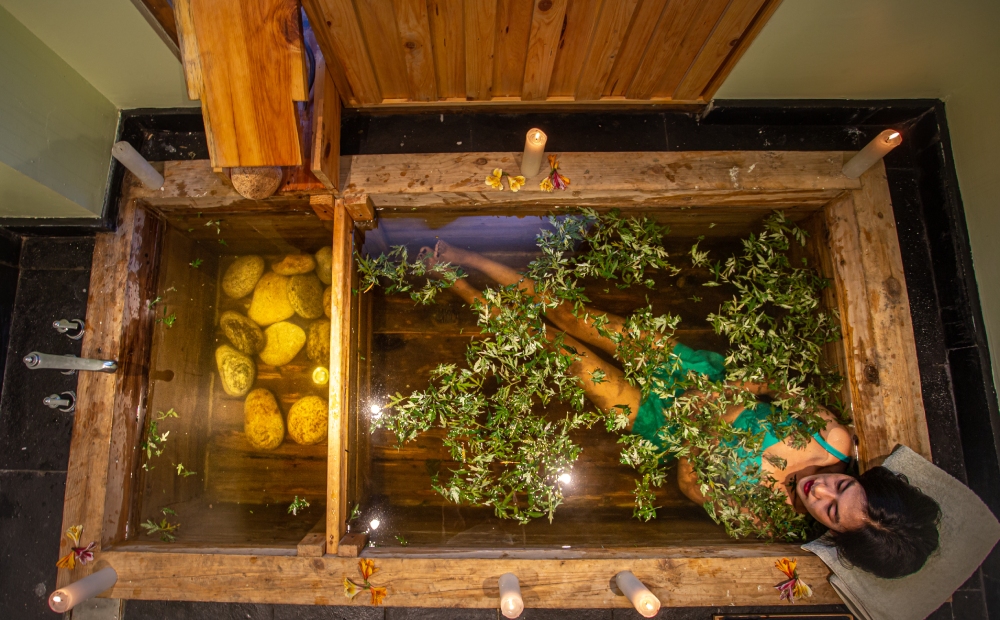
Every lodge on this circuit includes daily wellness elements as standard — this isn't an add-on you book separately. Expect an arrival spa ritual at each new lodge, guided meditation sessions where relevant, and spa treatments available throughout, with Thimphu and Punakha having the most developed facilities for longer sessions. Meals, non-alcoholic beverages, in-lodge activities, and private guide and driver coordination between lodges are built into the rate. For the full breakdown of what's included, what isn't, and current 2026–27 pricing across all five lodges, the Six Senses Bhutan pricing guide has the complete numbers.
If you're weighing whether Six Senses' wellness-forward structure suits you better than Amankora's more architecture-led philosophy, our piece on the Amankora circuit is a good place to start. And on what "luxury" should even mean for a trip like this, whether it's the room or the access, that's an argument worth its own page — I don't have a live link for it yet.
Frequently Asked Questions
Is seven days enough for Six Senses Bhutan?
Yes, for a first journey covering Paro, Thimphu, and Punakha — this is the sequence we recommend for travellers new to Bhutan, and seven nights is the minimum for it not to feel rushed. Trying to add Gangtey or Bumthang into the same week usually means sacrificing depth somewhere else on the circuit.
Which Six Senses Bhutan lodges does this itinerary cover?
Three of the five: Paro, Thimphu, and Punakha. Gangtey and Bumthang are extraordinary but suit a return journey better, once the western circuit is familiar and you have time to give them proper attention.
Can this itinerary include Gangtey or Bumthang instead?
Yes — this is a starting structure, not a fixed package. Some travellers prefer to swap Thimphu for Gangtey on a first trip. We build every itinerary around your dates, pace, and what you're hoping to get out of the week, not a template.
What is a typical day like on this trip?
Slower than most people expect from a "luxury itinerary." Mornings usually have one anchor activity — a hike, a temple visit, a cultural site — followed by open time at the lodge in the afternoon, and evenings built around a meaningful meal or experience rather than a full schedule. Nothing is back-to-back by design.
Do I need to be physically fit for this itinerary?
The Tiger's Nest hike is the main physical requirement — two to four hours of climbing at altitude. Everything else on this itinerary is walking-paced. If the hike is a concern, we can adjust timing, pace, or substitute a shorter route, and your guide will always read your capability rather than push a fixed plan.
How is this different from booking directly with Six Senses?
Booking the lodges directly gets you the rooms. It doesn't get you the farmhouse relationship in Punakha, the guide briefed specifically on your interests and pace, or an itinerary built around your dates rather than a standard package. Bhutanese law requires a licensed guide and operator regardless of how you book, so the practical choice is really about depth of access, not logistics.
Tell Us Your Dates
The itinerary above is a starting point, not a fixed script. Every journey we build is shaped around when you're travelling, how much time you actually have, and what you're hoping this week gives you back.
Tell us your dates and what's drawing you to Bhutan, and we'll come back with a specific week — lodges, pacing, and the moments worth building around — within 24 hours.